Battery Backup for Houston Pet Boarding and Grooming Facilities

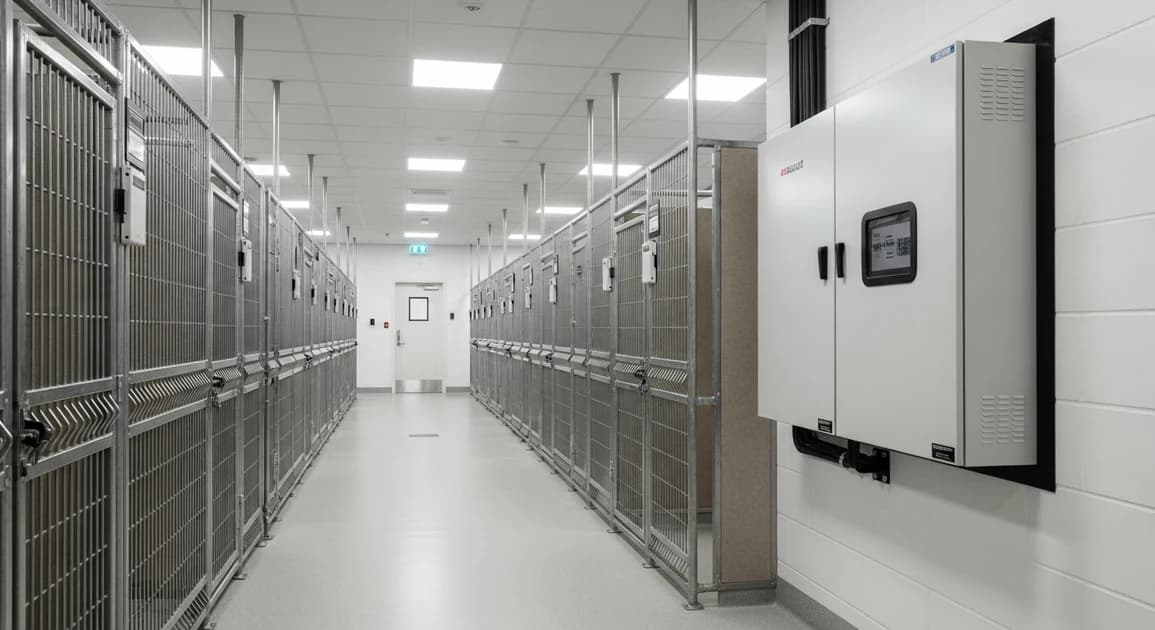
In a Houston July, an air-conditioned kennel does not stay safe for long once the power drops. The animals inside are not yours. Boarding, daycare, and grooming operators hold custodial responsibility for other people's pets, and an outage turns a facilities problem into a liability, refund, and reputation problem within hours. This article covers the loads that matter, how fast a kennel gets dangerous, what a single outage costs, and the battery sizing range that covers it. If you're protecting pets at home rather than animals in your custody, see our guide to battery backup for Houston pet owners and HVAC continuity for the residential angle. The facility, loads, and dollar figures below describe a composite Houston-area boarding and grooming operation, modeled from published industry rates, kennel ventilation standards, and Gulf Coast outage data. It is not a single real customer. Your numbers will differ.
[INTERNAL-LINK: check if your facility qualifies for a 30 to 80 kWh commercial system → /home-backup-planner?source=blog&slug=battery-backup-houston-pet-boarding-grooming]
Key Takeaways
- Indoor temperature in a closed Houston kennel can cross the 85F heat-stress zone within a couple of hours of losing HVAC, sooner for flat-faced breeds.
- Four systems fail together the moment the grid drops: cooling, mechanical ventilation, the client-facing camera feed, and the sanitation laundry cycle.
- Most Houston boarding and grooming facilities need 30 to 80 kWh of battery, sized HVAC first, not by animal headcount.
- Grooming force dryers draw 1.0 to 2.2 kW each and are a peak-demand problem, not a big energy draw, so a smart panel should shed them before it sheds cooling.
- A dead camera feed during a regional outage generates a wave of anxious owner calls even when every animal is fine, because the feed is a trust product families pay to watch.
What Happens to a Boarding Kennel When the Power Goes Out?
Four systems fail at once: cooling, mechanical ventilation, the camera feed clients watch from home, and the sanitation laundry cycle. In Gulf Coast summer conditions, the cooling failure is the one on a clock. Hurricane Beryl left more than 2.2 million Houston-area customers without power in July 2024, with hundreds of thousands still out on day eight (Houston Public Media, 2024).
Most boarding facilities carry no standby generator. Budgets go to kennel construction, staffing, and marketing, not backup power, so when the grid drops, nothing picks up the load. Staff response usually starts with propping doors for airflow, which works against the building: hot, humid outside air comes in faster than it cools anything, and open doors turn a controlled facility into an escape risk with 30 or more anxious animals inside. Most Gulf Coast outages start with a storm, which means the loss often lands at night or on a weekend, when the fewest staff are on-site to manage a full house through a heat event.
Citation capsule. A Houston-area outage disables kennel HVAC, ventilation, cameras, and laundry sanitation at once, because most boarding facilities carry no standby generator, turning a routine outage into a custodial emergency for every animal on site.
Why Kennel HVAC Is Life Safety, Not Comfort
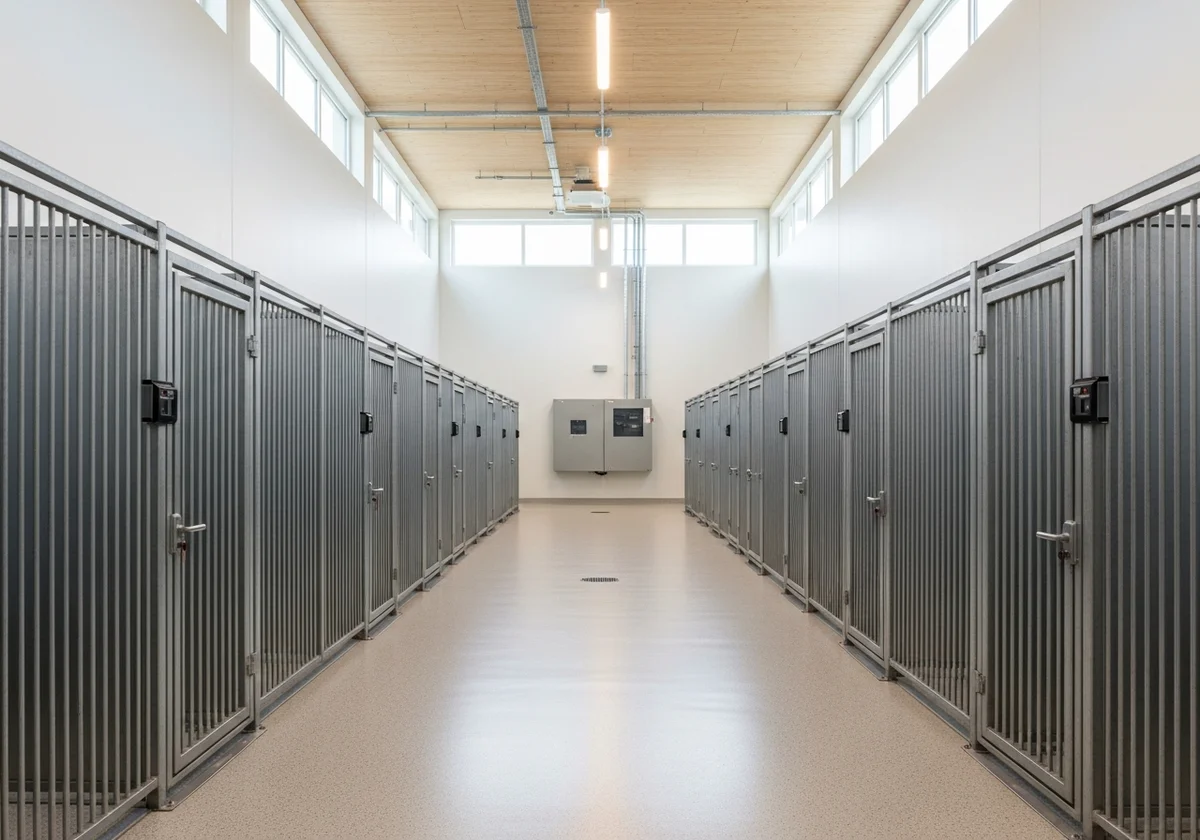
Veterinary guidance treats ambient temperatures above roughly 82 to 85F as the onset zone for canine heat stress, and brachycephalic breeds, bulldogs, pugs, French bulldogs, and Boston terriers among them, overheat well below that threshold. That single fact reframes kennel cooling from a comfort setting to a life-safety system with a countdown attached.
Heat stress and heatstroke sit on the same curve. Once a dog's core body temperature reaches roughly 104F, cellular damage begins. At 106F, multi-organ failure can start within minutes (Cornell Riney Canine Health Center, 2025). A closed kennel building holding 30 to 50 metabolizing animals heats faster than an empty room the same size, since every dog is a small heat source, and humidity multiplies the risk by slowing evaporative cooling through panting. Flat-faced breeds are now a meaningful share of most Houston boarding populations, and their restricted airflow means they slide into distress at temperatures a Labrador tolerates for hours. Size for the worst-case breed mix in the building, not the average one.
Ventilation and Disease Control: The Second Load Nobody Budgets For
Kennel ventilation standards call for roughly 8 to 20 air changes per hour, and that exchange is what keeps the respiratory-pathogen load down between dogs. When the fans stop, the germ load climbs alongside the temperature, and a facility that skated by on cooling alone can still end up with a sick population. AVMA companion animal care guidance and shelter-medicine references commonly cite 10 to 20 room air changes per hour for animal housing, and kennel design guidance runs 8 to 20 ACH depending on density (AVMA companion animal care guidelines; dvm360 kennel design references, 2023-2025). Canine infectious respiratory disease complex, the umbrella term for kennel cough, spreads through droplets and aerosols and worsens fast in high-density, poorly ventilated space (Association of Shelter Veterinarians, 2025). A facility that ships home a run of coughing, feverish dogs after a multi-day outage does not lose one weekend of bookings. It loses months of trust, because owners talk to each other before they talk to a search engine.
[INTERNAL-LINK: read our guide to battery backup for Houston veterinary clinics → /blog/battery-backup-houston-veterinary-clinics]
Grooming Loads: Dryers, Washers, and the Surge Problem
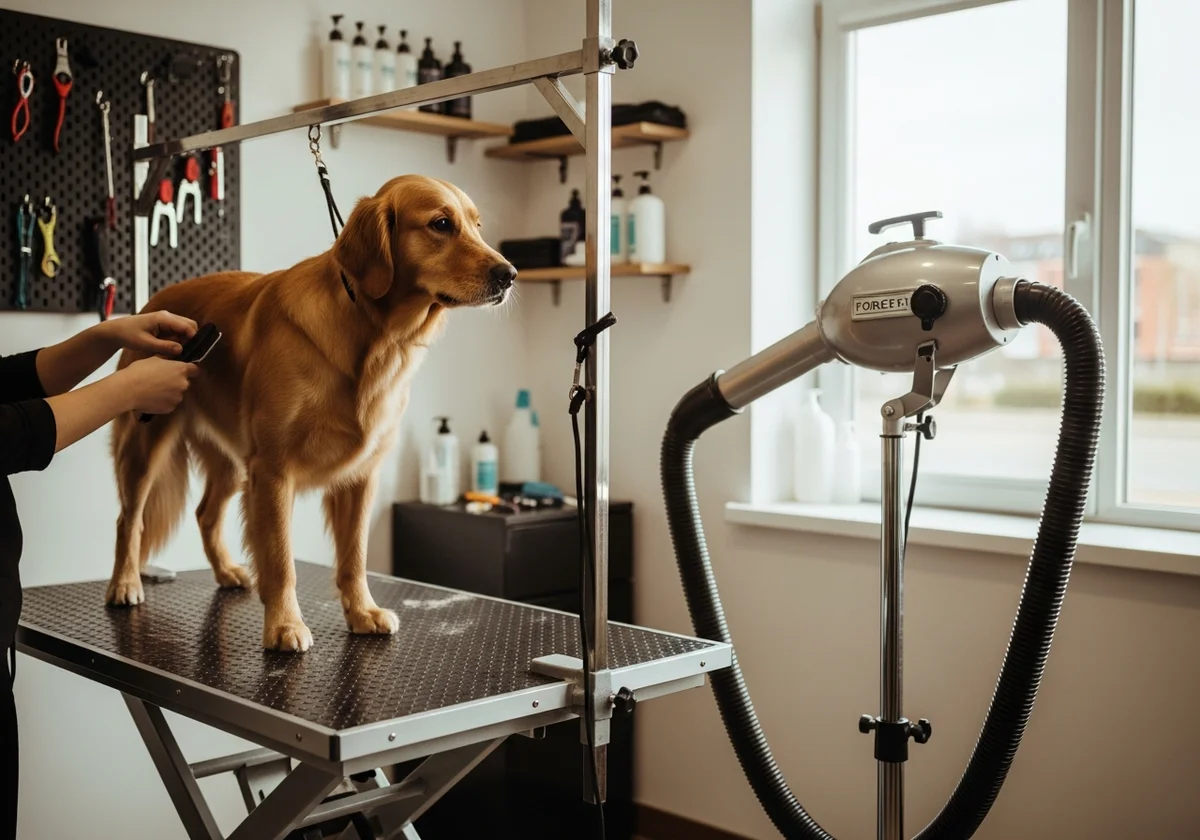
Grooming is a small share of daily kilowatt-hours but a large share of peak demand. Professional force dryers draw roughly 1.0 to 2.2 kW each on typical 12 to 15 amp circuits, and running two or three at once alongside a commercial washer and dryer can spike a small building past its backup inverter rating even when the total daily energy use is modest. The daily sanitation laundry cycle, bedding, towels, kennel linens, is both a hygiene obligation and a genuine load that runs every day the facility is open, bath or no bath.
This is where load prioritization through a smart panel matters more than raw battery capacity. A well-configured system sheds the grooming circuit first during an outage and keeps kennel HVAC and ventilation running uninterrupted. Grooming can pause for a few hours; cooling and air exchange cannot. Some composite operators shed grooming entirely during a declared outage and simply reschedule appointments, treating boarding continuity as the non-negotiable line.
[INTERNAL-LINK: see how Eos backs up Texas commercial buildings → /solutions/commercial]
What Does One Outage Actually Cost a Houston Boarding Facility?
Model it. National boarding rate benchmarks run roughly $25 to $55 per night for standard kennels and $75 to $150 for luxury suites (HomeGuide dog boarding cost survey, 2026), so a 40-animal house at a Houston-typical rate carries meaningful nightly revenue. A mid-stay evacuation refunds most of that revenue while costing more in labor and transport than the refund itself. A full outage stacks several costs at once: refunded nights, emergency staffing, transport and placement, veterinary treatment for heat-stressed animals, cancelled forward bookings, and spoiled prescription diets or refrigerated medications. The US has more than 20,000 pet care facilities and roughly 9,000 boarding kennels across the US and Canada (Dogster pet daycare and boarding industry statistics, 2026), a routine operating risk for a large industry.
The hardest cost to model is where evacuated animals actually go. A regional outage hits the whole metro, not one facility, so there is often nowhere to send 40 dogs on a storm day when every other boarding facility nearby is dark too.
The Webcam Is a Product, Not an IT Line Item
Client-facing kennel cameras draw very little power and protect the single thing an outage damages fastest: trust. Backing up the camera, NVR, router, and modem is one of the cheapest lines on the whole load list, and arguably the one with the highest return per kilowatt-hour.
Boarding customers buy peace of mind, and many check the live feed daily while their pet is away. Consider what happens when 40 owners lose that feed at the same moment during a regional outage: phones start ringing within minutes, and every ring is an anxious owner asking if their dog is safe. A facility that keeps the feed alive, then sends a proactive text confirming every animal is fine, converts a scare into a demonstration of competence. A facility that goes dark converts it into refund requests and one-star reviews, even when every animal was fine the whole time.
[UNIQUE INSIGHT] No competitor content in this space frames the camera feed as revenue protection rather than a security accessory. It costs almost nothing in kilowatt-hours to keep alive and it is the fastest thing an anxious owner checks, which makes it one of the best-returning line items in the entire backup budget.
How Much Battery Does a Houston Kennel or Grooming Salon Need?
Most Houston boarding and grooming facilities land between 30 and 80 kWh, sized HVAC first. Grooming-only salons with no overnight animals sit at the bottom of the range. Overnight boarding operations with 30 or more runs sit at the top, because cooled square footage and HVAC tonnage drive the number, not headcount.
What changes the number: whether the facility boards overnight or runs daycare-only, whether the plan is partial backup (HVAC, ventilation, cameras, refrigeration) or whole-building coverage, and how many hours of runtime the operator wants before any generator support. A sensible load-priority order runs HVAC and ventilation first, then cameras and network, then refrigeration, then lighting and office, with grooming last.
Eos commercial tiers scale to match: Commercial Essential (36 kWh nominal) suits a grooming-only salon or a small daycare with no overnight boarding, Commercial Plus (54 kWh) and Commercial Pro (72 kWh) fit most mid-size boarding operations, and Commercial Premium (90 kWh) covers larger multi-building campuses with heavy HVAC tonnage. [INTERNAL-LINK: compare commercial battery tiers and sizing options → /plans/commercial]
Texas regulates boarding kennels primarily through Health and Safety Code Chapter 824, which sets definitions and written unattended-animal notice requirements, alongside city-level permits most Houston-area operators already carry. That is not legal advice, but the practical point holds either way: your written notice and custodial care obligations do not pause because the grid went down.
[INTERNAL-LINK: book a free Houston facility assessment → /home-backup-planner?source=blog&slug=battery-backup-houston-pet-boarding-grooming]
Call (713) 470-9182 to speak with our commercial team about sizing a system for your facility.
FAQ
How hot is too hot inside a boarding kennel?
Veterinary guidance flags heat-stress risk once ambient temperature climbs past roughly 82 to 85F, sooner for flat-faced breeds and in high humidity (Cornell Riney Canine Health Center, 2025). Core temperatures near 104F begin cellular damage, and 106F can trigger multi-organ failure within minutes, which is why kennel cooling is treated as life safety, not comfort.
What size battery does a dog boarding facility need?
Most Houston facilities need 30 to 80 kWh, driven by cooled square footage and HVAC tonnage rather than animal count. A grooming-only salon with no overnight boarding sits near the low end. A facility with 30 or more overnight runs and multiple conditioned buildings sits near the top.
Can battery backup run grooming dryers?
Yes, but treat them as sheddable. Force dryers draw roughly 1.0 to 2.2 kW each, a peak-demand problem more than an energy problem. A properly configured smart panel keeps kennel HVAC and ventilation online first and sheds grooming circuits automatically if the load stack gets tight.
Is a boarding facility liable if a pet is harmed during a power outage?
General duty-of-care principles apply, alongside Texas Health and Safety Code Chapter 824 requirements and local permit obligations. Exposure depends on each facility's lease, insurance policy, and local ordinances, so operators should confirm specifics with their own counsel and insurer rather than relying on general guidance like this article.
Is battery backup better than a generator for a kennel?
Compare on what kennels actually care about. A battery transfers power in under 20 milliseconds with no manual start, runs silently (a running generator can agitate boarded dogs all night), and produces no exhaust near ventilated animal housing. A generator needs fuel on hand, hard to guarantee when every gas station line is an hour long. For multi-day events, a battery paired with a generator is the strongest combination. See our [INTERNAL-LINK: comparison of commercial battery backup and generators for Texas businesses → /blog/commercial-battery-backup-texas-businesses] for the fuller breakdown.
Conclusion
For a Houston boarding, daycare, or grooming operator, an outage is not an inconvenience. It is a custodial liability event the moment the first dog starts panting. HVAC failure runs on a clock measured in hours, ventilation loss is a disease-control problem as much as a comfort one, grooming is a peak-demand load that can be shed without shutting down boarding, and the camera feed is the cheapest trust asset in the building. Most Houston facilities land in the 30 to 80 kWh range, sized HVAC first, with load priority set so cooling and air exchange survive no matter what else gets shed.
The facility, loads, and dollar figures in this article describe a composite Houston-area boarding and grooming operation. It is not a single real customer, and your numbers will differ.
[INTERNAL-LINK: get a Houston commercial battery backup quote in under 2 minutes → /home-backup-planner?source=blog&slug=battery-backup-houston-pet-boarding-grooming]
Call (713) 470-9182 to talk through sizing for your specific facility.
Sources
- Houston Public Media, Hurricane Beryl outage reporting, retrieved 2026-07-27, https://www.houstonpublicmedia.org/
- Cornell Riney Canine Health Center, canine heat stress and heatstroke guidance, retrieved 2026-07-27, https://www.vet.cornell.edu/
- American Veterinary Medical Association, companion animal care guidelines, retrieved 2026-07-27, https://www.avma.org/
- Association of Shelter Veterinarians, canine infectious respiratory disease complex guidance, retrieved 2026-07-27, https://www.sheltervet.org/
- HomeGuide, dog boarding cost survey, retrieved 2026-07-27, https://homeguide.com/costs/dog-boarding-cost
- Dogster, pet daycare and boarding industry statistics, retrieved 2026-07-27, https://www.dogster.com/
- Eos Backup and Battery commercial load sizing data, 2026