Battery Backup for Houston Funeral Homes and Mortuaries: Refrigeration and Service Continuity

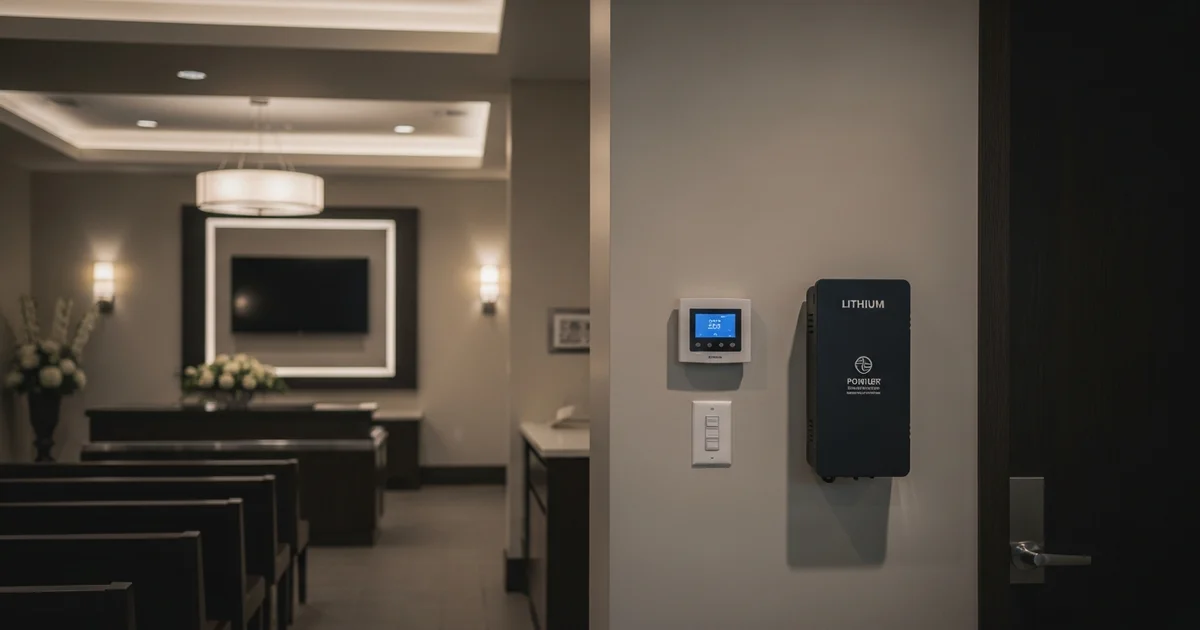
During Hurricane Beryl in July 2024, roughly 2.2 million CenterPoint customers across the Houston area lost power, and parts of the metro waited more than a week for restoration (Houston Public Media, 2024). For most businesses, a multi-day outage means closing the doors and absorbing the loss. A funeral home does not have that option. Cold storage cannot pause. Prep-room ventilation cannot stop. And a visitation scheduled for that evening cannot be moved to next week.
This guide walks one composite Greater Houston funeral home through the loads that matter, the sizing math, and what a battery system protects. The funeral home, its loads, and the timeline below are a composite built from public outage data, OSHA safety standards, and Eos commercial install experience. It is not a single real client, and no names are used.
[INTERNAL-LINK: get a Houston battery backup quote in under 2 minutes → /home-backup-planner?source=blog&slug=battery-backup-houston-funeral-homes-mortuaries]
Key Takeaways
- During Hurricane Beryl in 2024, about 2.2 million CenterPoint customers lost power, some for over a week (Houston Public Media, 2024).
- A funeral home runs three loads that cannot be interrupted: cold storage of the deceased, prep-room exhaust ventilation, and the scheduled-service calendar.
- Cold storage is the single non-negotiable load. It requires continuous power, with no safe pause window during a multi-day Texas outage.
- Prep-room exhaust is a safety load that must run while the room is in use, under the OSHA formaldehyde standard (29 CFR 1910.1048).
- Most Houston funeral homes land in a 40 to 120 kWh battery range, and battery backup is silent and emissions-free, which matters most inside a chapel.
Why does an outage hit a funeral home differently?
A funeral home runs three loads that cannot tolerate interruption: cold storage of the deceased, prep-room ventilation, and a scheduled-service calendar that is emotionally and legally time-bound. Unlike a restaurant that closes for a day, a funeral home cannot reschedule a family's grief. A visitation set for 6 PM cannot be moved the way a dinner reservation can.
Families arrive with legal, religious, and personal expectations about timing. A service often anchors travel plans, out-of-town relatives, clergy schedules, and burial or cremation arrangements that are already booked. When the grid drops three hours before a visitation, the operator cannot simply post a note on the door.

[UNIQUE INSIGHT] The hidden load in this vertical is reputation. A funeral home's entire business rests on reliability during the worst days of a family's life. A service disrupted by darkness, heat, or a generator roaring outside the chapel is not a minor inconvenience. It is the memory a grieving family keeps. That is a reputational event no marketing budget can undo.
Citation capsule. During Hurricane Beryl in July 2024, roughly 2.2 million CenterPoint customers across Houston lost power, with some waiting more than a week for restoration (Houston Public Media, 2024). For a funeral home, that window threatens cold storage, prep-room safety, and scheduled services at the same time, three things that cannot be paused or rescheduled.
Why is cold storage the non-negotiable load?
Refrigerated cold-storage units are the single load a funeral home cannot lose. They must hold proper temperature continuously, regardless of grid status, and there is no safe pause window to ride out a multi-day Texas outage. Cold storage sits at the top of every funeral home's load priority, above ventilation, comfort, and lighting.
A cold-storage bay holds the deceased ahead of services, identification, and family viewing. A temperature excursion is not recoverable the way a warm office is. The dignity owed to the family and the legal handling expectations both depend on that unit staying cold from the moment of intake through the final disposition.
[CHART: horizontal bar, title="Funeral Home Load Priority by Criticality", series=["Cold storage (critical) 5","Prep-room exhaust (safety) 4","Chapel HVAC and lighting (service) 3","Office, phones, records 2","General lighting 1"], source="Eos composite funeral home load assessment, 2026"]
ERCOT, the Texas grid operator, issued multiple grid conservation appeals across 2023 and 2024 as demand strained supply during heat waves (ERCOT, 2024). Stack that on top of hurricane-season restoration timelines, and the planning assumption for any Houston funeral home is simple. Cold storage may need to run for days, not hours, with no grid behind it.
[INTERNAL-LINK: cold-chain continuity for medical and dental practices → /blog/battery-backup-medical-dental-practices-texas]
Can a battery keep embalming and prep-room ventilation running?
Yes. Prep-room exhaust ventilation is a safety load, and a properly sized battery keeps it running whenever the room is in use. Under the OSHA formaldehyde standard, exposure must be controlled while staff work with embalming chemicals, which makes exhaust ventilation a continuity requirement, not a comfort feature.
The OSHA formaldehyde standard (29 CFR 1910.1048) sets permissible exposure limits and requires engineering controls, including ventilation, to keep airborne formaldehyde below those limits (OSHA, 2025). When a prep is underway, the exhaust system protects the embalmer. Losing power mid-prep is a safety problem, not just a workflow problem.
There is a difference between scheduled prep work and emergency intake. Scheduled work can sometimes be timed around a known outage, but intake does not wait for the grid. A battery sized to carry the exhaust fans keeps the room usable on the operator's schedule, not the utility's.
Citation capsule. The OSHA formaldehyde standard (29 CFR 1910.1048) requires engineering controls, including ventilation, to keep airborne formaldehyde within permissible exposure limits while staff work (OSHA, 2025). For a funeral home, prep-room exhaust is a safety load that ranks just behind cold storage in any backup plan.
A composite Houston scenario: outage during a scheduled visitation
Picture a composite Greater Houston funeral home with two cold-storage bays, an active prep room, and a 6 PM visitation booked when the grid drops at 3 PM on a July afternoon. This operator is a composite, not a real client. The decisions below show how the loads stack up in real time when the power fails on a service day.
At 3 PM the grid drops. Outside, neighbors' generators cough to life. Inside, the battery has already carried the transfer without a flicker. The two cold-storage bays never warmed. The prep room, mid-afternoon, still has working exhaust. Nothing about the building's critical functions changed in that first second.

By 4 PM the operator's attention turns to the evening. The chapel needs lighting, the air conditioning needs to hold a comfortable setpoint for a Houston summer evening, and the family is still arriving at 6. The battery carries chapel HVAC and lighting alongside the two critical loads it never dropped. There is no generator noise inside, no exhaust fumes drifting toward the entrance.
[PERSONAL EXPERIENCE] In our commercial assessments across the Houston metro after Beryl, the operators most worried about a repeat were not chasing a green story. They had watched a storm threaten a service and never wanted to make that call again. The fear was specific. A family in mourning standing in a hot, dark chapel while a generator droned outside.
At 6 PM the visitation proceeds on time. The chapel is cool, quiet, and lit. The family never knows the grid is down. That is the entire point. The service is not a near miss the operator talks about later. It is a non-event, which for a funeral home is the highest compliment a backup system can earn.
How big a battery does a funeral home need?
Most Houston funeral homes land in a 40 to 120 kWh battery range, driven by cold-storage count, prep-room activity, and chapel size. A small single-chapel home with one or two cold-storage bays sits at the lower end. A multi-chapel facility with higher cold-storage capacity and larger HVAC loads moves toward the upper end.
The sizing inputs are straightforward to count. How many cold-storage units, and their continuous draw. Prep-room exhaust wattage and how often the room runs. Chapel HVAC tonnage and lighting for the comfort load during services. Add a margin so cold storage rides through a multi-day event, and the battery size follows from the loads, not a guess.
[CHART: lollipop, title="Funeral Home Battery Sizing Tiers (approximate kWh)", series=["Small single-chapel home 45","Mid-size multi-service home 80","Large multi-chapel facility 115"], source="Eos composite funeral home sizing, 2026"]
Oversizing for cold storage is the safe default. Cold storage is the load you cannot afford to lose, so sizing the battery to carry it through the longest realistic Houston outage, then layering the prep room and chapel on top, is the conservative engineering choice. For larger facilities, a battery paired with a generator covers events that run beyond what any single battery should be asked to hold.
Across our Houston commercial work, funeral homes generally fit the Eos commercial battery plans, with sizing matched to the building. We size by name and load tier rather than a one-size number, because a two-bay home and a multi-chapel facility are different problems.
[INTERNAL-LINK: check if your home or facility qualifies for a 9 to 45 kWh system → /home-backup-planner?source=blog&slug=battery-backup-houston-funeral-homes-mortuaries]
What about cost, ROI, and the reputational stakes?
For a funeral home, the return is not only avoided spoilage. It is protecting services that cannot be redone and a reputation built on reliability during families' hardest days. The math is different from a retail business, because a single botched service carries a cost that does not fit neatly on a spreadsheet.
Think about cost relative to one ruined service. A funeral home's reputation in its community spreads through word of mouth among grieving families, clergy, and care facilities. One memorable failure, a service held in a hot dark chapel, travels far. Weighed against that, the cost of a battery system reads differently than a simple payback table suggests.
The comparison with a generator is where this vertical is unique. Generators run loud and emit exhaust, and they need refueling through a multi-day outage. None of that belongs near a chapel during a service. A battery is silent and emissions-free. The feature that matters least in a warehouse matters most inside a room full of mourners.
[UNIQUE INSIGHT] Most generic commercial backup pages never name the loads a funeral home actually runs, and generator-only sellers cannot make the silence argument at all. A generator's noise and fumes are uniquely damaging in exactly the setting a funeral home depends on. Battery backup is strongest precisely where a generator is worst.
[INTERNAL-LINK: the real per-event cost of a power outage for Texas businesses → /blog/business-interruption-power-outage-cost-texas]
Getting started in the Houston metro
The first step is a load assessment: count the cold-storage units, measure the prep-room exhaust, and define the chapel comfort load you need to hold during a service. From there, sizing is matched to the building's electrical panel and the loads you have prioritized, not a generic template.
A site assessment covers the panel, the critical loads, the physical space for the equipment, and the local permitting path. Most funeral home installs are sited in a back-of-house mechanical area or on an exterior pad, with sizing that carries cold storage through a multi-day event and the chapel through a scheduled service.
[INTERNAL-LINK: book a free Houston home assessment → /home-backup-planner?source=blog&slug=battery-backup-houston-funeral-homes-mortuaries]
Call (713) 470-9182 to speak with our commercial team about your facility.
FAQ
How long can a funeral home cold-storage unit hold without power?
A cold-storage unit holds proper temperature only while it has power. There is no safe pause window to wait out an outage. The practical answer for Houston is that cold storage needs continuous power, which means a battery sized for multi-day Texas outages. During Beryl in 2024, some areas waited over a week (Houston Public Media, 2024), so the planning assumption is days, not hours.
What size battery backup does a funeral home need?
Most Houston funeral homes fall in a 40 to 120 kWh range. The size depends on three inputs: how many cold-storage units you run, how active the prep room is, and the size of the chapel HVAC and lighting load. A small single-chapel home sits near the lower end, while a multi-chapel facility with more cold storage moves toward the upper end. A load assessment sets the exact number.
Can a battery keep embalming-room ventilation running during an outage?
Yes. Prep-room exhaust ventilation is a priority safety load, and a properly sized system carries it. The OSHA formaldehyde standard (29 CFR 1910.1048) requires ventilation controls while staff work with embalming chemicals (OSHA, 2025). Sizing the battery to power the exhaust fans keeps the prep room usable on your schedule, not the grid's.
Is battery backup better than a generator for a funeral home?
For a chapel setting, battery backup has a clear edge. It runs silently and emits nothing, so a service proceeds with no noise or fumes near mourners. A generator runs loud, vents exhaust, and needs refueling during a multi-day outage. Many funeral homes pair a battery with a generator for the longest events, but the battery carries the service hours cleanly.
Conclusion
The composite Houston funeral home in this article is not a real business, but its loads are real and they apply across the metro. Cold storage is non-negotiable. Prep-room ventilation is a safety load. Scheduled services cannot be rescheduled the way a closed restaurant reopens the next day. Sizing for most homes runs 40 to 120 kWh, and the system stays silent and emissions-free in exactly the room where that matters most.
For the next storm season, the goal is the same one the composite operator reached at 6 PM with the grid down: a service that proceeds on time, and a family that never knows anything was wrong.
[INTERNAL-LINK: get a fixed-price install quote for your address → /home-backup-planner?source=blog&slug=battery-backup-houston-funeral-homes-mortuaries]
For broader context, see our complete guide to commercial battery backup in Texas.