Battery Backup for Your Houston Home Theater and Media Room

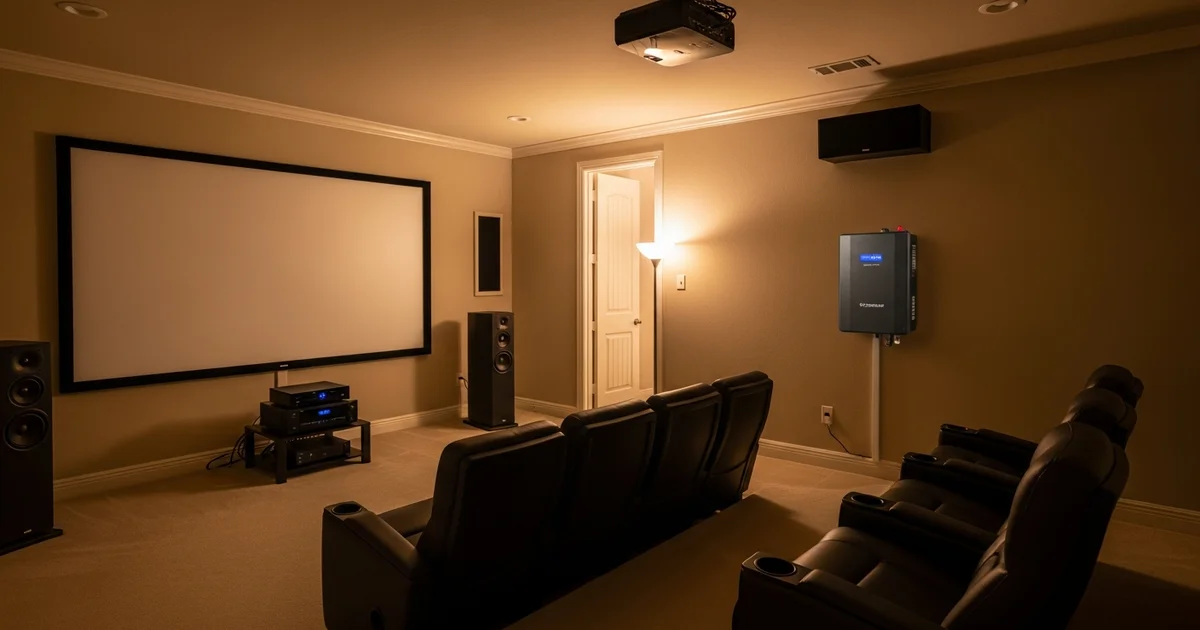
You built the media room for exactly this kind of night: rain on the roof, a movie queued up, everyone settled into the recliners. Then the storm that set the mood takes out the power, and the screen goes black mid-film. That is the annoying part. The expensive part comes later, when the grid snaps back on and a restoration surge hits every component still plugged into the wall. A dedicated Houston theater rack often carries $5,000 to $30,000 in projectors, receivers, amps, and media servers. This guide breaks down what those components really draw, why the moment power returns is the bigger threat, and which battery size both runs the room and protects it.
[INTERNAL-LINK: get a Houston battery backup quote in under 2 minutes -> /home-backup-planner?source=blog&slug=battery-backup-home-theater-media-room-houston]
Key Takeaways
- A full theater rack (projector, AV receiver, subwoofer amp, media server) draws only 600W to 1.2 kW, a light load for a whole-home battery.
- The bigger threat is the surge when power comes back: restoration transients can destroy electronics outright or quietly shorten their life, per State Farm and insurance-forensics firm Alpine Intel.
- A hard power cut skips a lamp projector's cool-down fan cycle, which seriously shortens bulb life, per AV industry guidance.
- A whole-home battery both runs the room and sits between the grid and every circuit, so the rack never sees the restoration transient; a point surge protector only clamps at one outlet.
- The Plus tier (18 kWh) covers a full movie night with the media room mini-split running, plus household essentials.
How much power does a home theater actually use?
Less than most owners guess. A home theater projector draws 150 to 400W depending on its light source, with 4K laser models typically in the 150 to 350W range, per Valerion and BLUETTI projector power guides. An AV receiver averages around 120W in normal listening and only climbs toward 300 to 500W when driven hard, per Audio Champs. Add a subwoofer amp at 100 to 300W, a media server or game console at 150 to 300W, and a streaming stick at under 20W, and the whole rack lands between 600W and 1.2 kW.
That is roughly the draw of a microwave. For an 11.5 kW continuous inverter, it barely registers.
The load that actually moves the math is the same one we found in Houston home gyms: cooling. Most dedicated media rooms here are interior, windowless spaces, and the mini-split that keeps one watchable in summer pulls 1.2 to 3 kW while running, per Mitsubishi Electric datasheets. During a July outage, that room gets stuffy fast, so the AC, not the projector, sets your energy budget.
The real killer is the surge when power comes back
Outages rarely damage AV equipment. Restoration does. When the grid re-energizes after an outage, inrush current and voltage transients hit everything still plugged in, and per State Farm, small surges quietly shorten the life of electronics while large ones destroy circuit boards outright. Insurance-forensics firm Alpine Intel reports that insurers see high volumes of power-surge claims after major outage events, especially hurricanes.
A theater room is unusually exposed to this. It concentrates semiconductor-dense, always-plugged-in devices on a couple of circuits: a projector, a receiver full of DSP boards, an amp, a server, a game console. One bad re-energization event can touch all of them at once.
Houston knows what repeated re-energization looks like. When Hurricane Beryl hit in July 2024, more than 2.2 million CenterPoint Energy customers lost power across the metro, and restoration rolled out over days, neighborhood by neighborhood. Every one of those re-energization events pushed a transient through homes that were still plugged in and waiting.
Lamp projectors face a second, quieter problem. A hard power cut skips the cool-down cycle, where the fan keeps running after the lamp shuts off, and skipping it seriously reduces bulb life, per AV Gadgets. Laser projectors tolerate hard cuts better, but no manufacturer recommends them.
Citation capsule. Power outages interrupt movie night, but restoration is what damages home theater equipment: per State Farm, surges when the grid re-energizes can destroy electronics or shorten their life, and Alpine Intel notes insurers see surge claims spike after major outage events. A whole-home battery isolates the rack from those transients entirely.
Whole-home battery vs surge protector vs UPS: which layer does what?
They are layers, not alternatives. A point surge protector clamps voltage spikes at one outlet. A rack UPS buys minutes of runtime for a graceful shutdown. A whole-home battery is the only layer that both isolates the entire house from grid transients and keeps the movie running for hours.
| Layer | Surge protection | Runs the show? | Runtime |
|---|---|---|---|
| Point surge protector | Clamps spikes at one outlet | No | None |
| Rack UPS (1350 to 1500VA) | Filters its own outlets | Minutes | Cool-down and shutdown only |
| Whole-home battery | Isolates every circuit from the grid | Yes | Hours |
The standard advice in AV forums stops at the middle row. Per RhimoPower's home theater UPS guide, the typical recommendation is a 1350 to 1500VA unit, which supports roughly 810 to 900W. That is enough to finish the projector's cooling cycle and power down cleanly. It protects the ending, not the movie.
A whole-home battery works differently. During an outage, the house runs on the battery through the inverter, disconnected from the grid. When the grid comes back unstable, or re-energizes with a transient, the system rides through it and reconnects on its own schedule. The rack never sees the event. Keep a quality surge strip at the rack as a second layer, and if you run a lamp projector without whole-home backup, a small UPS is still worth having. We compare the options in detail in our guide to surge protectors and battery backup.
What size battery runs a Houston media room through an outage?
For a projector-based theater plus household essentials, the Plus tier (18 kWh nominal, 17.52 kWh usable) is the fit. Here is the movie-night math. A full rack running at about 1 kW for a 2 hour 15 minute film uses roughly 2.3 kWh. A 2.5 kW media room mini-split cycling at about 60% duty adds around 1.5 kWh per hour, another 3.4 kWh over the evening. Call it 5 to 6 kWh for the whole cooled movie night, about a third of the Plus system's usable capacity. The rest keeps the fridge, Wi-Fi, and lights running through the outage.
| Setup | Typical load | Recommended size |
|---|---|---|
| TV + soundbar + streaming, no AC | Under 500W | Essential (9 kWh) |
| Projector rack + media room mini-split | 2 to 3 kW | Plus (18 kWh) |
| Theater + whole-home cooling, or multi-day outages | 3 kW and up | Pro (27 kWh) |
Startup loads are not a concern here. The smart controller delivers 11.5 kW continuous with 17.1 kW of surge handling, so amplifier inrush and the mini-split compressor kicking on do not faze it.
[INTERNAL-LINK: see the Plus plan for theater plus essentials -> /plans/plus]
If this sizing logic sounds familiar, it should: it is the same AC-dominates-the-math finding from our Houston home gym backup guide. The equipment is a rounding error; the cooling is the budget. For sizing the whole house rather than one room, start with the Houston home battery backup guide.
What happens to the theater when the grid comes back?
With a whole-home battery, nothing. The movie does not stutter, the projector never hard-cuts, and no restoration transient reaches the rack. The system re-syncs to the grid once it stabilizes, then recharges itself automatically for the next event. The same isolation logic applies to computers and monitors, which is why we recommend it for home office electronics too.
[INTERNAL-LINK: book a free Houston home assessment -> /home-backup-planner?source=blog&slug=battery-backup-home-theater-media-room-houston]
Or call our Houston office at (713) 462-2202 to size a battery around your equipment list and media room cooling.
FAQ
How many watts does a home theater use?
A typical dedicated theater rack draws 600W to 1.2 kW in use: a projector at 150 to 400W, an AV receiver around 120W in normal listening, a subwoofer amp at 100 to 300W, and a media server or console at 150 to 300W, per Valerion and Audio Champs power guides. The media room mini-split, at 1.2 to 3 kW, usually outdraws the entire rack.
Can a power surge damage my projector or AV receiver?
Yes, and the highest-risk moment is when power comes back after an outage. Per State Farm, large surges destroy electronics outright and small ones shorten their lifespan over time, and Alpine Intel reports insurers see surge claims spike after major outage events. Receivers and projectors are semiconductor-dense and usually stay plugged in, which makes them prime targets.
Do I still need a surge protector if I have a whole-home battery?
Keep it. The battery inverter isolates your circuits from grid transients, which is the layer no power strip can provide, but a quality surge protector at the rack adds cheap defense against events that originate inside the house, like a motor kicking on. Think of it as a stack: whole-home isolation first, point protection second.
Do I need a UPS for my projector?
Only if you run a lamp projector without whole-home backup. A hard power cut skips the lamp's cool-down fan cycle, which seriously shortens bulb life per AV Gadgets, and a 1350VA UPS exists mostly to carry the projector through that cycle and shut things down. With a whole-home battery, the projector never loses power in the first place, so the UPS becomes optional.
How long can a battery run a media room?
A full movie night, cooling included, uses about 5 to 6 kWh: roughly 1 kW of rack draw plus a mini-split cycling at about 1.5 kWh per hour. On the Plus tier's 17.52 kWh of usable capacity, that is two or three feature films, or one movie night with a full day of household essentials on top. Rack-only viewing with no AC stretches far longer.
The bottom line
A Houston home theater faces two distinct threats, and they arrive in order. First the outage interrupts the movie. Then the restoration surge, the one almost nobody plans for, threatens the $5,000 to $30,000 of equipment sitting on the rack. Point surge protectors and rack UPS units each solve a slice of the problem; a whole-home battery solves both ends of it, running the full movie night with the room's cooling and standing between the grid and your circuits when power snaps back. For most projector-based rooms, the Plus tier (18 kWh) runs the show and the essentials with capacity to spare.
[INTERNAL-LINK: get a fixed-price install quote for your address -> /home-backup-planner?source=blog&slug=battery-backup-home-theater-media-room-houston]