7 Red Flags When Hiring a Battery Backup Installer in Texas

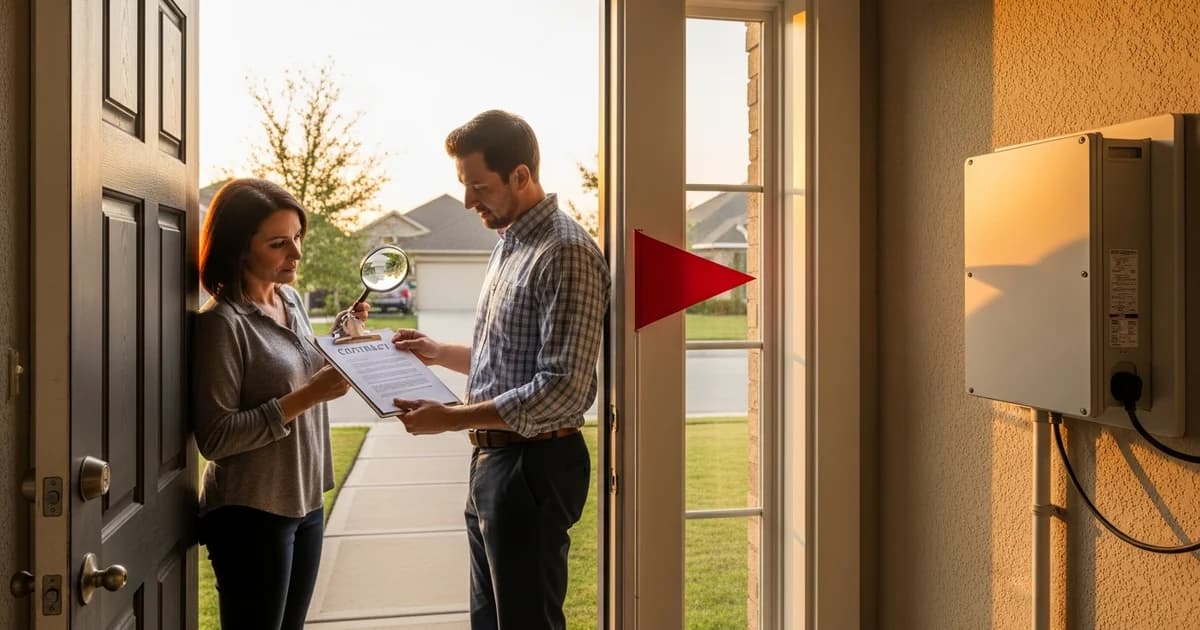
7 Red Flags When Hiring a Battery Backup Installer in Texas
Complaints about solar and battery sales tactics in Texas rose more than 800% between 2018 and 2023 (KXAN, 2023). In April 2026, the Texas Attorney General opened a formal fraud initiative against companies selling residential solar and battery systems, citing more than 100 written complaints and thousands more logged informally (Texas Attorney General, 2026).
A home battery is a four to five figure purchase, and in the worst cases it gets sold at your front door with a countdown timer attached. Below are 7 concrete red flags, what each one looks like in the wild, why it burns homeowners, and what to do instead.
Key Takeaways
- Texas complaints about solar and battery sales soared more than 800% between 2018 and 2023, and the FTC logged over 7,000 solar fraud complaints in 2025 alone.
- Since September 1, 2025, Texas SB 1036 requires residential solar and battery retailers to register with TDLR, with penalties up to $100,000 for violations.
- Verify any installer's TECL number free at tdlr.texas.gov before signing. A missing or borrowed license is an automatic no.
- Houston requires an electrical permit for home battery installs, and NEC Article 706 governs the work. "You don't need a permit" is a walk away line.
- A fixed price quote after a real site survey, a deposit well under half the price, and clear equipment ownership are the baseline of a legitimate deal.
[INTERNAL-LINK: get a fixed-price install quote for your address → /home-backup-planner?source=blog&slug=battery-installer-red-flags-texas]
1. Door-to-Door Pressure and "This Price Is Only Good Today"
A rep knocks unannounced, mentions a "utility program" or "government project," and says the price expires the moment they walk off your porch. In 2026, the FTC, CFPB, and Treasury ran a joint consumer initiative flagging exactly this pattern in solar and battery sales, and the FTC logged over 7,000 solar fraud complaints in 2025 alone (FTC / Treasury, 2024).
Why it burns homeowners: urgency is a sales tactic, not a pricing reality. A battery system priced honestly today will still be priced honestly next week. Rushing you past comparison shopping is the point. Texas SB 1036 now bans false claims of utility or government affiliation in these sales calls outright.
What to do instead: ask for the quote in writing and take a week to think it over. If you signed at the door, federal law gives you a 3-business-day cooling-off right to cancel, no reason required. Report pressure tactics at reportfraud.ftc.gov.
In one sentence: if the price only exists while the salesperson is standing on your porch, it was never a real price to begin with.
2. No Verifiable TECL License, or a Borrowed One
Look for a license number on the truck, the contract, and the company's website. If it's missing, or the rep says the crew "works under a partner's license," stop there. In one 2025 enforcement sweep, Texas Department of Licensing and Regulation (TDLR) investigators found 74 potential violations tied to unlicensed or improperly licensed electrical work (TDLR, 2025).
Why it burns homeowners: unlicensed electrical work can void your homeowners insurance claim and fail inspection outright, leaving you to pay for a redo. Since September 1, 2025, SB 1036 also requires residential solar and battery retailers to register with TDLR, with penalties up to $100,000 for bad actors, particularly those targeting seniors (TDLR, 2025).
What to do instead: run a free lookup at the TDLR License Search before you sign anything. The company shows up under a TECL number, and the individual electricians show up separately as Master or Journeyman. Both need to read Active, not Expired or Pending.
When we survey a home before quoting, the first thing we pull up on the customer's laptop, next to them, is our own TECL number in the TDLR database. Every legitimate installer should be comfortable doing the same for their license and yours.

3. A Deposit Over 50% Before the Permit Is Even Filed
Some reps ask for 60 to 70% down "to lock in the equipment," before a permit application has even been filed. Large pre-work deposits are a documented red flag called out directly in the 2024 federal consumer solar awareness initiative (Treasury, 2024).
Why it burns homeowners: if the company folds before the job is finished, that deposit is usually gone, and so is the warranty behind it. Houston has already seen this play out. BBB Houston's complaint file on Sunnova, a Houston-headquartered solar and battery company that filed for bankruptcy in 2025, documents customers left with voided warranties and dead systems after paying substantial sums up front (BBB Houston, 2025).
What to do instead: insist on milestone-based payments. A modest deposit up front, with the balance tied to permit approval, installation, and a passed inspection, protects you if anything goes sideways mid-project.
[INTERNAL-LINK: see your monthly payment for whole-home backup → /home-backup-planner?source=blog&slug=battery-installer-red-flags-texas]
4. Vague Answers About Who Owns the Equipment
Ask directly: "Do I own this battery?" A straight answer should take five seconds. If the contract reads like a lease, or the rep calls it an "energy service agreement" and dodges the ownership question, that's the flag.
Why it burns homeowners: subscription and lease structures mean the company, not you, controls the battery. It can be cycled for the provider's own grid revenue, and the hardware never becomes an asset on your side of the ledger. When a subscription provider runs into financial trouble, homeowners are often left holding a third-party agreement they have no ability to service or exit cleanly.
What to do instead: get ownership terms in writing before you sign, not after. For a full breakdown of ownership versus subscription battery models in the Houston market, including how Base Power's subscription structure compares to ownership, see our [INTERNAL-LINK: ownership vs subscription battery models in Houston → /blog/eos-vs-base-power-houston-ownership-vs-subscription]. Ownership-based plans, sized from Essential at 9 kWh up through Premium at 36+ kWh, put the equipment title in your name from day one.
[INTERNAL-LINK: ownership-based battery plans from 9 to 45 kWh → /plans]
5. "You Don't Need a Permit"
An installer offers to skip the permit "to save you time and fees." Treat this as an immediate stop sign, not a convenience.
Why it burns homeowners: home battery systems in Texas fall under NEC Article 706, which governs disconnects, listing, and labeling requirements for energy storage (IAEI Magazine, 2019). Houston requires an electrical permit for residential energy storage system work, and the Houston Permitting Center applies International Fire Code electrical storage system standards to that work (Houston Permitting Center, 2026). Unpermitted installs tend to surface at the worst possible moments: a home sale, an insurance claim, or a fire inspection, and they can fail unsafely with no inspector ever having checked the wiring.
What to do instead: ask who is pulling the permit and with which authority having jurisdiction. The permit line should show up as its own item on the itemized quote, not get folded into a vague "install fee."
Here's how documented complaint volume has climbed as these sales tactics spread across Texas:
6. A Quote Without a Site Survey
The exact dollar price gets quoted over the phone, or at the door, in under 10 minutes, with no one looking at your electrical panel, your roofline, or your breaker box.
Why it burns homeowners: panel capacity, service upgrade needs, mounting location, and which circuits get backed up all change the real installed cost. A "quote" produced without a survey is a guess, and it becomes a moving target the moment the crew shows up and finds a 100-amp panel where they expected 200 amps.
Every quote we send follows a free site survey, not the other way around. We're checking panel capacity, the mounting wall, and which circuits you actually want backed up, because those three things are what separate a real number from a placeholder. For a full walkthrough of what that survey covers, see [INTERNAL-LINK: what a real battery quote includes → /blog/battery-backup-quote-houston-what-to-expect].
What to do instead: if a company will not commit to a free in-person or virtual survey before locking a price, treat the number they gave you as a placeholder, not a quote. For a breakdown of how marketplace quotes compare to direct installer quotes in Texas, see [INTERNAL-LINK: marketplace quote vs direct installer quote → /blog/energysage-quote-vs-direct-installer-quote-texas].
7. Reviews That Cannot Be Verified, or All Posted the Same Week
Forty five-star reviews appeared in a single month, none of the reviewers have any other review history, and there's no BBB profile at all, or there is one and it's full of unanswered complaints.
Why it burns homeowners: a cluster of same-week reviews is a classic sign of an incentivized review push rather than organic customer feedback. BBB Houston profiles for several regional solar and battery companies show a repeating pattern: unresolved complaints, systems that stopped working, and warranties voided after a parent company's bankruptcy.
What to do instead: check BBB Houston directly under Solar Energy Contractors, and read how the company responded to complaints, not just the star average. Then ask the installer for two recent local references you can actually call.
License, permit, ownership, survey, deposit terms, and reviews: any single red flag on this list is a reason to slow down. Two or more is a reason to walk away entirely.
[INTERNAL-LINK: book a free Houston home assessment → /home-backup-planner?source=blog&slug=battery-installer-red-flags-texas]
Prefer to talk it through instead? Call Eos at +1 833-989-3737 and ask us the hard questions first, we'd rather answer them before you sign than after.
Frequently Asked Questions
How do I verify a battery installer's license in Texas?
Use the free TDLR License Search at tdlr.texas.gov. The company should carry an active TECL number, and each electrician on the crew should carry an active Master or Journeyman license under their own name, not a borrowed company number.
How much deposit is normal for a home battery installation?
A modest deposit tied to milestones, permit approval, installation, and passed inspection, is standard. A demand for 50% or more before any permit has been filed is a documented red flag flagged by federal consumer protection agencies.
Do I need a permit for a home battery in Houston?
Yes. Home battery installs fall under NEC Article 706, and Houston requires an electrical permit for residential energy storage system work under Houston Permitting Center standards. An installer who says otherwise is skipping a legally required inspection step.
What does Texas SB 1036 change for battery buyers?
Since September 1, 2025, SB 1036 requires residential solar and battery retailers to register with TDLR, bans false claims of utility or government affiliation, and carries penalties up to $100,000 for violations, particularly those targeting elderly homeowners.
Can I cancel a battery contract I signed at my door?
Yes. Federal law gives buyers a 3-business-day cooling-off right to cancel contracts signed away from a seller's regular place of business, no reason required. Report suspected fraud at reportfraud.ftc.gov or to the Texas Attorney General's consumer protection office.
Sources
- KXAN, Texans Fight to Get Out of Solar Panel Contracts as State Oversight Promised, retrieved 2026-07-01, https://www.kxan.com/investigations/texans-fight-to-get-out-of-solar-panel-contracts-state-oversight-promised/
- Texas Attorney General, Attorney General Ken Paxton Launches Major Initiative to Combat Widespread Fraud by Companies Selling Residential Solar and Battery Systems, retrieved 2026-07-01, https://www.texasattorneygeneral.gov/news/releases/attorney-general-ken-paxton-launches-major-initiative-combat-widespread-fraud-companies-selling
- U.S. Department of the Treasury, Consumer Solar Awareness, retrieved 2026-07-01, https://home.treasury.gov/policy-issues/consumer-policy/consumer-solar-awareness
- Texas Department of Licensing and Regulation (TDLR), TDLR Investigators Find 74 Potential Violations, retrieved 2026-07-01, https://www.tdlr.texas.gov/media/pressrelease/2025-08-19-tdlr-investigators-find-74-potential-violations.pdf
- Texas Department of Licensing and Regulation (TDLR), Residential Solar Retail Sales Now Regulated by TDLR, retrieved 2026-07-01, https://www.tdlr.texas.gov/media/pressrelease/2025-09-03-residential-solar-retail-sales-now-regulated-by-tdlr.pdf
- BBB Houston, Sunnova Energy International Inc. Complaint Profile, retrieved 2026-07-01, https://www.bbb.org/us/tx/houston/profile/solar-energy-design/sunnova-energy-international-inc-0915-90035524/complaints
- IAEI Magazine, Energy Storage Systems: NEC Article 706, retrieved 2026-07-01, https://iaeimagazine.org/2019/2019march/energy-storage-systems-nec-article-706/
- Houston Permitting Center, Electrical Energy Storage System Requirements, retrieved 2026-07-01, https://www.houstonpermittingcenter.org/media/9346/download?inline=
The Short Version
For the flip side of this checklist, the specific questions to ask before you sign, see [INTERNAL-LINK: the questions to ask before you sign → /blog/questions-to-ask-battery-installer-houston].