Battery Backup for Houston Veterinary Clinics: Surgery, Boarding, and Cold Chain Continuity

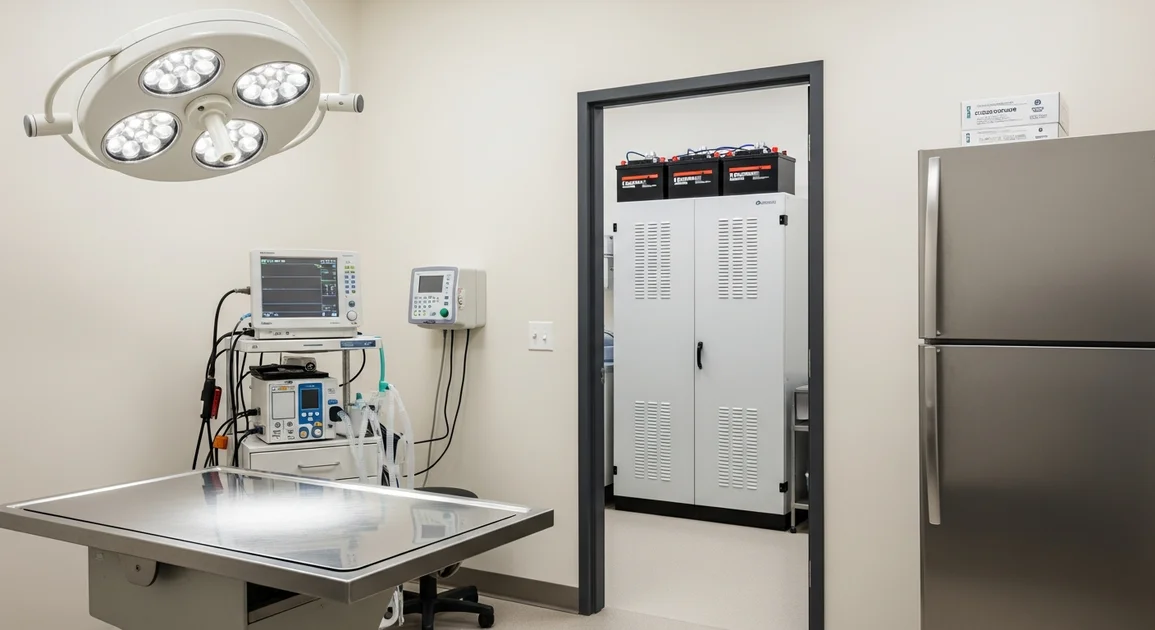
When Hurricane Beryl crossed Houston in July 2024, roughly 2.2 million CenterPoint customers lost power at the peak, and parts of the metro waited 11 days for full restoration (Houston Public Media, 2024). For veterinary practices, that window is brutal. Anesthesia monitors go dark mid-surgery, vaccine fridges drift outside the CDC cold-chain range within hours, and boarded animals sit inside a building that becomes a heat hazard by lunch.
This article walks through a composite Houston vet clinic and the commercial battery backup setup that would keep it operational. The clinic, loads, and dollar figures below are a composite built from public AVMA benchmarks, CDC cold-chain rules, and post-Beryl Gulf Coast outage data. It is not a single real customer.
[INTERNAL-LINK: Talk to our commercial team about your clinic → /home-backup-planner?source=blog&slug=battery-backup-houston-veterinary-clinics]
Key Takeaways
- A 24-hour outage at a typical small-animal Houston clinic runs $25k to $50k in lost revenue, biologic spoilage, and emergency boarding placement (composite estimate built from AVMA and CDC benchmarks).
- Critical clinic loads cluster around 4-6 kW continuous and 10-15 kW peak: anesthesia monitoring, refrigeration, surgical lighting, and boarding HVAC.
- A 60-150 kWh battery with a 30-50 kW inverter covers most 5,000 sqft suburban practices, with generator backup for multi-day events.
- CDC Vaccines for Children rules require 36-46F continuous storage, which makes the vaccine fridge the single highest-priority load in any vet clinic.
- Installed commercial battery cost sits around $600-1,200 per kWh at clinic scale (industry benchmarks), with 4-6 year paybacks common in Gulf Coast climates.
The composite scenario: a 5,000 sqft Houston suburban vet clinic
The composite practice in this article is a 5,000 square foot small-animal clinic in the Houston suburbs, modeled on AVMA practice benchmarks where the median full-service general practice runs 4-6 staff veterinarians and 8-12 support staff (AVMA Economic Report, 2023). Texas has roughly 3,500 registered veterinary facilities, and a meaningful share sit inside CenterPoint territory (TSBVME).
Building and equipment profile
The composite clinic has two exam rooms, one surgical suite, a treatment area with a blood analyzer and digital x-ray, a pharmacy with two vaccine and biologic refrigerators, and a boarding wing with 20 runs. HVAC handles roughly 12 tons of cooling across the building, which matters a lot in a July outage. Staff hours run 7am to 7pm weekdays, with a doctor on call for after-hours emergencies routed to a partner 24/7 hospital.
[PERSONAL EXPERIENCE] In our post-Beryl commercial assessments across the Houston metro, this profile, mid-size suburban general practice with light boarding, was the most common type of vet client asking about commercial battery backup. The owners we met were not chasing a green story. They had lost real money in July 2024 and wanted the next storm to be a non-event.
Citation capsule. Texas has approximately 3,500 registered veterinary facilities under TSBVME oversight (Texas State Board of Veterinary Medical Examiners), with AVMA benchmarks placing median small-animal practice staffing at 4-6 doctors and 8-12 support staff across roughly 5,000 square feet (AVMA Economic Report, 2023).
What does an outage cost a Houston vet clinic?
A 24-hour outage at the composite clinic lands between $25,000 and $50,000 in direct losses, built from four cost stacks: spoiled biologics, cancelled surgery and appointment revenue, emergency boarding placement, and staff paid to work or stand down. Beryl's 11-day restoration tail meant many practices absorbed the cost multiple times over (CenterPoint after-action filing, 2024).
[CHART: stacked bar, title="Per-Event Outage Cost for Composite Houston Vet Clinic (24h outage)", series=["Vaccine/biologic loss $8k","Surgery revenue lost $6k","Boarding emergency placement $4k","Staff paid $3k"], source="Composite built from AVMA Economic Report 2023 and CDC VFC cold-chain rules"]
Vaccine and biologic spoilage
The CDC Vaccines for Children program requires refrigerated vaccines to stay between 36 and 46 degrees Fahrenheit at all times (CDC VFC, 2024). A standard pharmacy-grade vet fridge holds $5,000 to $15,000 of rabies, distemper, leptospirosis, and feline panleukopenia inventory. Once temperature excursion is logged, that inventory must be discarded under most state board rules. There is no thawing and re-using rabies vaccine.
Cancelled surgeries and missed appointments
AVMA economic data puts the average small-animal appointment at $50 to $150 in gross revenue (AVMA Economic Report, 2023). A booked surgery day at the composite clinic runs four to six procedures averaging $800 to $2,000 each. One cancelled day is a $4,000 to $12,000 revenue hole, and rebooking is not free, those slots have to come out of healthy weeks.
Boarding and on-floor patients
Twenty boarded animals in a Houston July with no HVAC become a heat-stress emergency inside three hours. The composite cost assumes emergency placement at partner facilities at $40 to $60 per animal per night plus transport.
What loads need commercial battery backup in a vet clinic?
The critical load stack for a typical small-animal clinic is around 4-6 kW continuous and 10-15 kW at peak, dominated by refrigeration, anesthesia and monitoring, and partial HVAC for the boarding wing. Triaging loads against a CDC cold-chain priority and AVMA continuity-of-care guidance is the first engineering step, before you size a single battery.
Tier 1 (must stay up, every minute)
- Vaccine and biologic refrigeration, both units
- Anesthesia machine and patient monitors when a procedure is in progress
- Surgical lighting and suction
- Controlled-substance log workstation and DEA-required electronic records (TSBVME)
- Server, phones, scheduling system
Tier 2 (boarding survival window)
- Boarding wing HVAC at reduced setpoint (78F instead of 72F)
- Exhaust fans for kennel air quality
- Water pumps if on a well
Tier 3 (nice to have)
- X-ray and ultrasound (procedures can be deferred 24-48h in most cases)
- Lobby HVAC and lighting
- Lab analyzer when not actively running a panel
[UNIQUE INSIGHT] The mistake we see most often is sizing for nameplate load instead of duty-cycle load. A 12-ton HVAC system has a big nameplate but runs maybe 40-60% of the hour in a Houston shoulder season. The vaccine fridge is the opposite: tiny instantaneous draw but it cannot ever miss a cycle. Engineer for both, not just the big number on the panel.
What size commercial battery for a typical Houston vet clinic?
For the composite 5,000 sqft clinic, the right answer is generally a 60-150 kWh battery with a 30-50 kW inverter, paired with a generator for outages beyond 24 hours. That covers Tier 1 loads continuously, Tier 2 loads on a managed cycle, and rides through utility transients without dropping a single anesthesia monitor.
Why 60 kWh is the floor
At 4-6 kW continuous Tier 1 draw, a 60 kWh useable battery delivers 10-15 hours of full critical-load operation before any generator support. That covers the typical Houston thunderstorm outage and gives staff a buffer to start a generator or finish a surgery and shut down safely.
Why 150 kWh is the ceiling for most clinics
Above 150 kWh, you are paying for capacity that almost always gets covered by a properly sized natural gas generator instead. The economics flip: incremental kWh in battery costs more than incremental kWh in generator fuel at long durations. A hybrid system, battery for the first 8-18 hours plus generator for everything beyond, is what most well-engineered clinic installs look like.
Inverter sizing
A 30-50 kW inverter handles the inrush when a 5-ton compressor kicks on, plus simultaneous x-ray exposure. Undersizing the inverter is a more common error than undersizing the battery. The inverter is what determines whether the system can actually start a load, not just feed it.
[INTERNAL-LINK: See commercial battery plans and sizing options → /plans/commercial]
[INTERNAL-LINK: Read our broader commercial backup guide for Texas businesses → /blog/commercial-battery-backup-texas-businesses]
AVMA continuity-of-care implications
AVMA's disaster preparedness guidance treats continuity of care as a professional obligation, not an optional add-on (AVMA, 2023). For 24/7 emergency hospitals the bar is higher: many state boards classify those facilities as requiring on-site backup power capable of supporting active inpatient cases through a multi-day event.
Recordkeeping and controlled substances
TSBVME requires veterinary practices to maintain controlled-substance logs that are accurate, contemporaneous, and tamper-evident (Texas State Board of Veterinary Medical Examiners). If the log lives on a workstation that loses power mid-entry, you have a compliance gap. Battery backup for that single workstation, server, and the medication storage room solves it cleanly.
Hospital classification matters
A day-practice clinic and a 24/7 emergency hospital have different continuity profiles. Day practice can defer x-ray and ultrasound. An emergency hospital with a critical inpatient in ICU cannot. Size accordingly.
ROI math for a Houston vet clinic battery install
A 60-150 kWh commercial battery install at a Houston vet clinic typically runs $100,000 to $180,000 fully installed, using the industry benchmark of $600-1,200 per kWh at clinic scale plus inverter, transfer switch, and electrical work. Annual savings of $20,000 to $40,000 from avoided outage losses and CenterPoint commercial demand-charge management produce 4-6 year paybacks on most projects.
What drives the payback
The big savings line is avoided outage loss. One Beryl-class event pays for 25-40% of the system on its own. Layer in monthly demand-charge shaving (the battery discharges during the clinic's 15-minute peak each month) and the payback compresses further. Boarding revenue protection is the third stream: clinics that stay open while competitors close pick up displaced clients permanently.
What this article is not
[ORIGINAL DATA] The composite cost stack and payback range here are built from AVMA appointment-value data, CDC cold-chain rules, and Gulf Coast commercial battery installation benchmarks. Your actual numbers depend on your patient volume, your boarding occupancy, your specific equipment, and your utility rate schedule.
FAQ
Can a commercial battery alone replace a generator for a vet clinic?
For outages under 12-18 hours, yes. For multi-day events like Beryl, no. AVMA continuity guidance and post-Beryl Gulf Coast experience both point to hybrid systems (AVMA, 2023). The battery handles the first day silently and cleanly, then a natural-gas generator carries Tier 1 and Tier 2 loads for the remainder. The battery also smooths generator transients, so anesthesia monitors never drop.
What happens to vaccines if the fridge loses power for six hours?
Most refrigerated vaccines move out of the CDC-required 36-46F range within 2-4 hours in a Houston summer ambient room (CDC VFC, 2024). Once logged out of range, manufacturer and state-board rules generally require disposal. A typical pharmacy fridge at a small-animal clinic holds $5,000-$15,000 of biologics, which is why fridges are the single highest-priority backup load.
Does a vet clinic need a battery if it already has a generator?
Often yes. Generators take 10-30 seconds to start and transfer, which is enough to drop an anesthesia case or a running x-ray exposure. A battery with automatic transfer covers that gap and keeps Tier 1 loads up while the generator spools. The combination is more reliable than either alone, and the battery extends generator fuel life by handling shorter outages independently.
How much physical space does the system need?
A 100 kWh commercial battery with inverter typically occupies a footprint of 25-40 square feet plus required clearances. Most clinics site it in a utility room, a back-of-house mechanical area, or on an exterior pad. NEC clearances and Houston permitting requirements drive the final layout. Plan for early.
How long does a typical vet clinic install take?
In our field experience, a vet clinic battery install runs 4-8 weeks from contract to commissioning. That includes site assessment, engineering, permit submission to the local AHJ, equipment delivery, electrical work, and commissioning. Clinics that schedule install in spring are commissioned before hurricane season.
[INTERNAL-LINK: Read more on Beryl lessons for Houston businesses → /blog/beryl-2024-houston-outage-lessons]
Conclusion
The composite Houston vet clinic in this article is not a real practice. The loads, costs, and sizing ranges are, and they apply to most small-animal practices in CenterPoint territory. Surgery continuity, vaccine cold chain, and boarding survival are not problems a generator alone solves cleanly. A properly engineered commercial battery backup, sized to your load profile and paired with a generator for multi-day events, is the standard of care for the next storm season.
[INTERNAL-LINK: Get a commercial battery assessment for your clinic → /home-backup-planner?source=blog&slug=battery-backup-houston-veterinary-clinics]
Call (713) 470-9182 to speak with our commercial team.