Battery Backup for Houston Machine Shops and Welding Fabricators

Most posts about commercial backup power end with a yes. This one does not, and that is the point. A machine shop or a welding fabricator runs loads that a single residential class controller was never designed to carry, and any installer who says otherwise is selling you a disappointment on the day you need the equipment most.
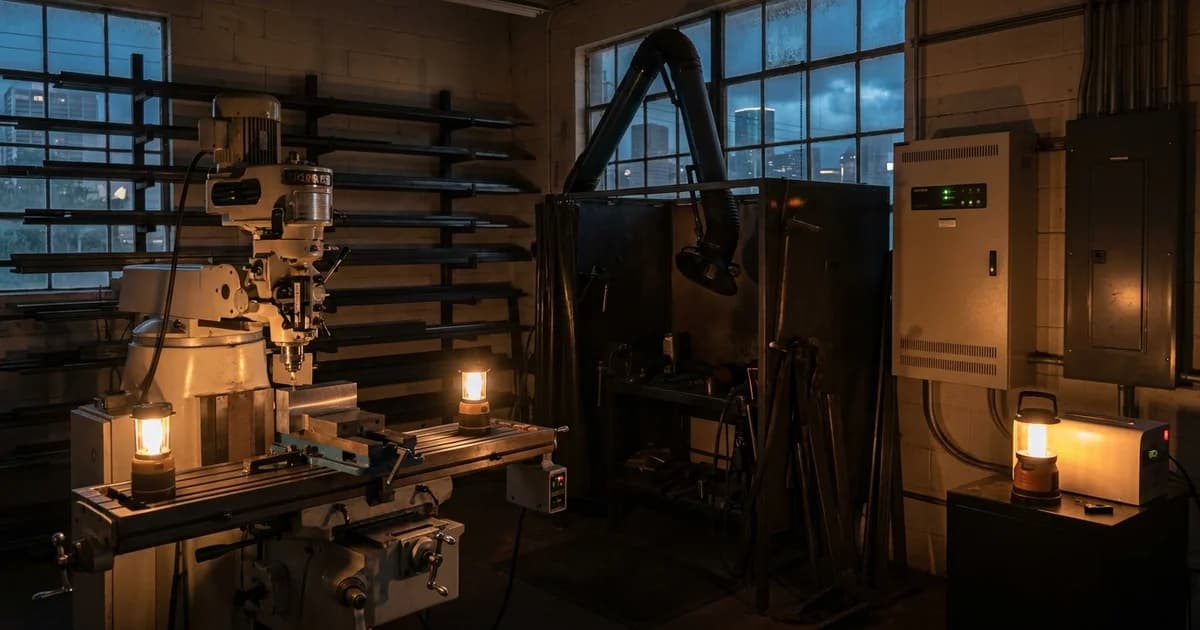
Here is the useful version. A battery will not run your production floor. It will protect the part in the spindle, the air your welders breathe, and the systems that let you quote, bill and lock up. Those three fit inside one controller.
The shop described here is a composite, assembled from public standards documents, federal regulations and Houston outage data. It is not a real customer. The loads, the failure modes and the sizing boundaries are real.
Key Takeaways
- Full three phase production is out of scope for a single controller. A large machining center, a heavy duty welder at duty cycle or a big rotary phase converter belongs in a generator or multi controller conversation.
- What does fit: an orderly CNC shutdown, fume and dust extraction, lighting, doors, security and the office layer.
- Extraction is regulated, not optional. Mechanical ventilation at a minimum of 2,000 cubic feet per minute per welder is required where a space holds less than 10,000 cubic feet per welder or has a ceiling under 16 feet (29 CFR 1910.252).
- One controller delivers 11.5 kW continuous and 17.1 kW surge, and that surge headroom is what starts a motor load instead of stalling it.
- In 2024, U.S. electricity customers averaged 11 hours without power, the most in a decade, with major events driving 80 percent of those hours (U.S. Energy Information Administration, 2025).
Can a battery run a Houston machine shop during an outage?
Partly, and the honest split matters more than the headline. In 2024, U.S. electricity customers averaged 11 hours of interruption, nearly nine of them from major events such as Hurricane Beryl (U.S. Energy Information Administration, 2025). Across those hours a battery can hold your safety, shutdown and business systems. It cannot hold your spindle.
That distinction is the design, not an apology. A shop rarely needs to keep cutting metal through a hurricane. It needs to not lose the part, not vent fume into a room full of people, and not lose the week of quoting and job tracking.
[UNIQUE INSIGHT] The priority order in a metal shop is the inverse of what most owners expect. Protect the atmosphere first, the part second, production last.
What a power loss actually does to a CNC mid cycle
It ends the part, and sometimes it costs more than the part. A machining center that drops power mid cycle stops with a tool engaged in the workpiece, and restoring power does not resume the cycle. The machine gets recovered by hand, the tool has to come out of the cut, and on many controls the axes need re-referencing before anything moves.
That recovery is where the second cost lives. Bringing a machine back to a known state with a tool still buried in stock is exactly the moment a careless restart becomes a crash, which is why industrial machinery standards treat restarting as a hazard in its own right. OSHA has addressed this for metalworking equipment after an unscheduled electrical outage, pointing to anti-restart protection so a machine does not come back to life on its own when voltage returns (OSHA standard interpretation, January 31, 2005). NFPA 79, the electrical standard for industrial machinery, carries the same requirement in its undervoltage provisions (NFPA, 2024).
A battery changes that sequence. Instead of a hard drop, the control keeps power long enough for a commanded stop, and the machine still holds program state and position when you walk up to it. Our write up on what a stopped job costs a print or sign shop makes the same argument in ink and vinyl. In metal, the scrap is heavier.
Welding fume extraction is a regulated load, not a convenience
Extraction is the one load in the building that a federal regulation names directly. Mechanical ventilation must run at a minimum of 2,000 cubic feet per minute per welder where welding happens in a space of less than 10,000 cubic feet per welder, in a room with a ceiling under 16 feet, or in confined spaces and areas where partitions or balconies obstruct cross ventilation (29 CFR 1910.252(c)(2)).
Read that as an electrical requirement, because that is what it becomes in an outage. If the extractor is off, the qualifying condition for welding in that bay is gone, whether or not the welder itself has power.
Stainless raises the stakes. Welding chromium bearing alloys generates hexavalent chromium, and OSHA sets a permissible exposure limit of 5 micrograms per cubic meter as an 8 hour time weighted average (OSHA, Hexavalent Chromium, publication 3373, 2009).
Grinding and finishing carry their own rule. Where dry grinding, polishing or buffing pushes employee exposure past the limits in 1910.1000, a local exhaust ventilation system must be provided and used, and OSHA publishes minimum exhaust volumes with recommended duct velocities of 4,500 feet per minute in the branch and 3,500 in the main (29 CFR 1910.94).
Motor loads, inrush, and what 11.5 kW continuous really means
Extractors, dust collectors and shop air are motor loads, and a motor does not draw its running current at the instant it starts. Federal efficiency rules define the common shop motor class by that behavior: a NEMA Design B motor is a squirrel cage motor whose locked rotor current must not exceed the values published in NEMA MG 1 (10 CFR 431.12).
Locked rotor current is the startup draw, and it is a multiple of the running draw. That is the whole reason a backup system quotes two numbers instead of one. Our controller delivers 11.5 kW continuous with 17.1 kW of surge, and the gap between those figures is what absorbs a compressor or extractor start without dragging the rest of the panel down with it.
The consequence is about sequencing, not just totals. Two large motors starting at the same instant behave very differently from two staged 20 seconds apart. On a shop survey we set the extractor as a priority circuit and stage the compressor behind it.
[PERSONAL EXPERIENCE] Owners almost always name the mill first when we walk a floor. The extractor, the roll up door opener and the office server get named last, and those are the three we end up backing.
The tier that is always worth backing up
Some loads are small, cheap to carry and disproportionately valuable when the lights go. They are also the ones nobody asks about.
| Load | Why it earns a circuit |
|---|---|
| Fume and dust extraction | Named in OSHA ventilation requirements, gates whether welding or grinding may continue |
| CNC control power | Enables a commanded stop and preserves program and position state |
| Shop and task lighting | Moving people safely around loaded racks, hot metal and open machines |
| Roll up door operators | A shop with dead door motors cannot ship, receive or clear a bay |
| Security, cameras, alarm | Open bays full of tooling and stock during a multi day regional outage |
| Office, network, quoting and job tracking | Billing, scheduling and customer communication survive the outage |
That list is the honest scope of one controller in a metal shop. It is not the machining center, but it is the difference between a shop that is closed and a shop that is only quiet.
Honest sizing: where the boundary sits
Here is the boundary stated plainly. A three phase machining center under load, a heavy duty welder running at a real duty cycle, or a large rotary phase converter feeding a bank of machines can exceed what one residential class controller delivers. That is an engineering fact about the equipment, not a hedge.
If your goal is to keep cutting metal through a multi day outage, the answer is a generator or a much larger multi controller design, and we will tell you that on the first call rather than the third. If your goal is to protect people, parts and the business layer while production pauses, a battery is the better instrument. It is silent and it carries no refueling logistics during a regional event.
Plenty of Houston shops end up wanting both, with the battery covering the always on tier and a generator sized for production. That is a legitimate design, not a failure of either technology. The trade-offs are laid out in our overview of commercial battery backup for Texas businesses.
What a Houston outage actually looks like for a shop
Long enough that shutdown planning stops being theoretical. Hurricane Beryl left roughly 2.2 million CenterPoint customers without power on July 8, 2024 (Houston Public Media, 2024), and around 250,000 were still out on the eighth day (Houston Landing, 2024). The Public Utility Commission of Texas later published an investigative report on the utility's response (The Texas Tribune, 2024).
A week is not a blip you ride out. It is a week of jobs and a week of open bays. The financial picture is broken down in our piece on what a power outage costs a Texas business, and the motor surge question is worked through in another vertical in our guide to backup power for Houston auto repair shops.
Or call Eos at 833-989-3737 to talk through your setup with an installer.
Frequently Asked Questions
Will a battery run my CNC machining center during an outage?
Not for production. One controller supplies 11.5 kW continuous and 17.1 kW surge, scoped to control power, a commanded stop and the shop's safety and business loads. A three phase machining center cutting under load is a generator or multi controller conversation, and we say so up front.
Can a battery keep my welding fume extractor running?
Usually yes, and it is the load we prioritize. OSHA requires mechanical ventilation at a minimum of 2,000 cubic feet per minute per welder in spaces under 10,000 cubic feet per welder or with ceilings under 16 feet (29 CFR 1910.252), so extraction gates the work itself.
What happens to a part if power drops mid cycle?
The part is normally scrap and the tool stops inside the cut. Recovery means backing the tool out and re-referencing the machine, which is why industrial machinery standards require protection against unintentional restart when voltage returns (NFPA 79, 2024).
Why does surge capacity matter more than total capacity in a shop?
Because motors draw far more current at startup than while running. Federal rules define NEMA Design B motors by a locked rotor current ceiling published in NEMA MG 1 (10 CFR 431.12). A system with no surge headroom simply fails to start the extractor.
Sources
- U.S. Energy Information Administration, "Hurricanes in 2024 led to the most hours without power in the United States in 10 years," retrieved 2026-09-08, https://www.eia.gov/todayinenergy/detail.php?id=66744
- eCFR, 29 CFR 1910.252, Welding, Cutting and Brazing, General Requirements, retrieved 2026-09-08, https://www.ecfr.gov/current/title-29/subtitle-B/chapter-XVII/part-1910/subpart-Q/section-1910.252
- eCFR, 29 CFR 1910.94, Ventilation, retrieved 2026-09-08, https://www.ecfr.gov/current/title-29/subtitle-B/chapter-XVII/part-1910/subpart-G/section-1910.94
- OSHA, "Hexavalent Chromium," publication 3373, retrieved 2026-09-08, https://www.osha.gov/sites/default/files/publications/OSHA-3373-hexavalent-chromium.pdf
- OSHA, Standard Interpretation on protecting against automatic restart of metalworking equipment after an unscheduled electrical outage, January 31, 2005, retrieved 2026-09-08, https://www.osha.gov/laws-regs/standardinterpretations/2005-01-31
- NFPA, "Overview of NFPA 79," retrieved 2026-09-08, https://www.nfpa.org/news-blogs-and-articles/blogs/2024/12/13/overview-of-nfpa-79
- eCFR, 10 CFR 431.12, Definitions, Electric Motors, retrieved 2026-09-08, https://www.ecfr.gov/current/title-10/chapter-II/subchapter-D/part-431/subpart-B/section-431.12
- Houston Public Media, "Houston power outages: Hurricane Beryl plunges 2.2 million into the dark," retrieved 2026-09-08, https://www.houstonpublicmedia.org/articles/news/hurricane/2024/07/08/492833/houston-power-outages-hurricane-beryl-centerpoint/
- Houston Landing, "CenterPoint reports 2 million customers restored, 250,000 still without power for 8th day," retrieved 2026-09-08, https://houstonlanding.org/centerpoint-reports-2-million-customers-restored-250000-still-without-power-for-8th-day/
- The Texas Tribune, "Public Utility Commission releases investigative report on CenterPoint Energy's Hurricane Beryl response," retrieved 2026-09-08, https://www.texastribune.org/2024/07/25/texas-power-grid-puc-centerpoint-hurricane-beryl/