Battery Backup for Houston Car Dealerships: Showroom to Service

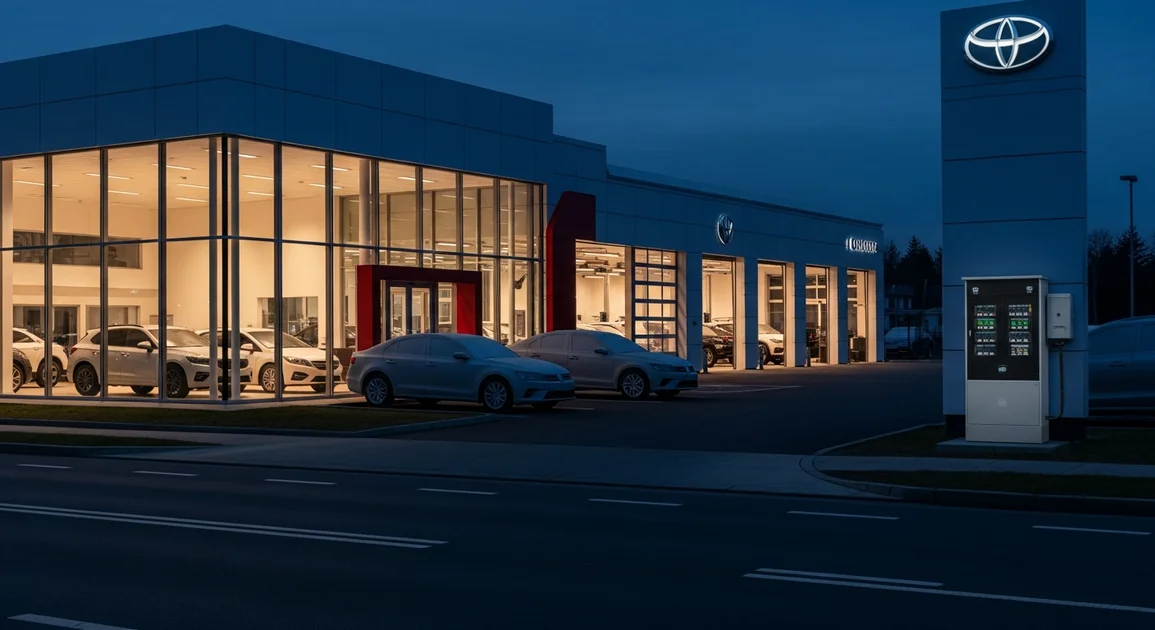
Battery Backup for Houston Car Dealerships: Showroom to Service
When the power drops at a Houston dealership, three revenue centers stop at once. The showroom goes dark and the finance office cannot close a deal without the dealer-management system, the service bays fall silent because the lifts and diagnostics run on grid power, and the lot loses lighting and security over a yard of expensive inventory. An outage hits all of it. Here is what battery backup can realistically protect, and how to size it.
Key Takeaways
- There are 16,957 franchised dealerships in the US selling more than $1.2 trillion a year (NADA, 2024), so hours of downtime carry real weight.
- Retail buildings average about 64 kBtu per square foot a year, led by heating and ventilation (EIA CBECS, 2018), and a dealership adds service-bay loads on top.
- Hurricane Beryl left about 2.2 million CenterPoint customers without power on July 8, 2024 (Houston Public Media, 2024), with roughly 226,000 projected to still be out eight days later (Texas Tribune, 2024).
- A bidirectional-capable EV can send power back to a building, which the DOE calls vehicle-to-building, subject to utility interconnection rules (DOE).
- Honest sizing: one controller protects a critical zone. A full dealership needs a larger commercial design.
[INTERNAL-LINK: get a backup quote for your dealership → /home-backup-planner?source=blog&slug=battery-backup-houston-car-dealerships]
Can a battery keep a Houston dealership running during an outage?
Yes, for the critical revenue and security systems, sized to the store. A battery can keep the dealer-management system, CRM, and finance office running so you can still close, a lit showroom zone presentable, the lot security live over your inventory, and a service bay or two working. That keeps the money moving. What one small unit will not do is run the whole showroom's air conditioning, every service bay, and the full lot at once, a larger multi-controller job.
That honesty shapes the plan. We back the systems that keep sales, service, and security alive first, then scale from there. A dealership rarely needs everything at once, but it always needs those.
Why an outage hits a dealership on three fronts
Because a dealership is really three businesses under one roof. Sales runs on computers: the dealer-management system, the finance and insurance office, CRM, and internet, none of which work in the dark, so a deal cannot close. Service runs on power: lifts, air compressors, and diagnostic equipment all need the grid, so an outage stops billable work in the bays. And the lot is a yard of high-value inventory that depends on lighting and security cameras.
Houston makes the risk concrete. During Beryl, about 2.2 million customers lost power and roughly 226,000 were projected to still be out more than a week later, in heat that pushed the index near 100 degrees (Texas Tribune, 2024). That is days of stopped sales and service, not hours.
Where a dealership's power goes
Across a lot of systems, which is why a full dealership is a large load. There is no dealership-specific building-energy category, but the showroom resembles a retail building, which averages about 64 kBtu per square foot a year, led by heating and ventilation (EIA CBECS, 2018). A dealership then stacks service-bay equipment, compressors, lifts, and diagnostics on top of that retail baseline, which is why the total climbs.
The EV angle: can a dealership's cars be part of the plan?
Increasingly, yes, with honest limits. If your dealership sells electric vehicles, bidirectional charging is a real emerging capability: the Department of Energy notes that a bidirectional-capable EV can send power back to a building, what it calls vehicle-to-building, though it also cautions that the site's utility interconnection agreement must permit reverse power flow (DOE). That caveat is real, and we design around it.
Our optional V2X module is rated 25 kW DC bidirectional, with a 3-year warranty on that module. It lets a compatible vehicle become part of a backup plan rather than just a product on the lot. It is a capability to design carefully, not a promise to make lightly. See our guide on [INTERNAL-LINK: EV charging continuity during Houston outages → /blog/battery-backup-ev-charging-continuity-houston].
A composite look: a dealership through a multi-day outage
The following is a composite illustration, not a specific client, drawn from the loads we see at Houston dealerships. Picture a franchised store: a glass showroom, a finance office running the dealer-management system, six service bays with lifts and compressors, a parts department, and a lot of inventory under lighting and cameras. When the grid drops, sales stop, the bays go quiet, and the lot goes dark.
With a battery system on a segmented critical plan, the finance office keeps closing deals, a showroom zone stays presentable, security holds over the inventory, and a couple of service bays keep billing. The dealership keeps earning through the outage instead of sending customers and technicians home. For the broader math, see our look at [INTERNAL-LINK: the cost of business interruption from a Texas power outage → /blog/business-interruption-power-outage-cost-texas].
How much battery does a dealership need?
More than most retail, because of the service side. A full dealership runs showroom HVAC, service-bay equipment, the DMS, and lot lighting and security, which is a big, segmented load. The realistic plan protects the critical revenue and security systems first, then scales across multiple controllers for broader coverage.
Here is the honest hardware picture. Our modular system uses 9 kWh nominal battery modules (8.76 kWh usable each), stacking to 45 kWh on one controller rated 11.5 kW continuous and 17.1 kW surge, with a 10-year warranty. One controller carries a critical zone: the DMS and finance office, security, a lit showroom area, and a service bay or two. A full dealership typically needs a commercial design in the 100 to 300 kWh range across multiple controllers.
[INTERNAL-LINK: see commercial battery options and sizing → /plans/commercial]
The right first question is which systems keep you selling and secure, not how many kilowatt-hours. Our guide on [INTERNAL-LINK: commercial battery backup for Texas businesses → /blog/commercial-battery-backup-texas-businesses] walks through that load-priority process.
[INTERNAL-LINK: talk through a dealership backup plan → /home-backup-planner?source=blog&slug=battery-backup-houston-car-dealerships]
Prefer to talk it through? Call Eos at 713-207-2222 for a same-week Houston commercial site survey.
Frequently asked questions
Can a battery keep my dealership selling during an outage?
Yes, if it covers the right systems. A battery can keep the dealer-management system, finance office, CRM, and internet running so you can close deals, plus a lit showroom zone and security. Those are the sales-critical loads. Running the entire store's air conditioning is a larger job we size separately.
Can it keep the service department working?
It can run a service bay or two, not usually all of them at once. Lifts, compressors, and diagnostics need power, and a right-sized battery keeps priority bays billing during an outage. A full service department across many bays needs a larger commercial system, which we design to your shop.
How big a battery does a car dealership need?
It depends on how much you protect. One 45 kWh controller covers a critical zone: the DMS, finance office, security, a showroom area, and a bay or two. A full dealership with showroom HVAC, all bays, and lot lighting typically needs a 100 to 300 kWh commercial design across multiple controllers. We size it to your store.
Can the EVs we sell provide backup power?
A bidirectional-capable EV can send power back to a building, which the DOE calls vehicle-to-building, if your utility interconnection allows reverse power flow (DOE). Our optional V2X module is rated 25 kW DC bidirectional. It is a real capability we design carefully around your site's rules.
Is a battery better than a generator for a dealership?
Each has a role. A battery is silent, fuel-free, and instant, which suits a customer-facing showroom, with runtime bounded by capacity. A generator adds longer runtime on fuel. Many dealerships use a battery for critical sales and security loads and add a generator for extended service-bay runtime.
This article is general information for Houston dealership operators and reflects Eos specifications as of July 2026. The case is a composite illustration, not a specific client, and does not promise a specific runtime or revenue outcome. Bidirectional charging depends on vehicle capability and utility interconnection approval. Confirm sizing, electrical code, and permitting for your site with the appropriate professionals.