Owning Your Home Battery vs a Monthly Subscription in Houston: The Long-Run Math

Owning Your Home Battery vs a Monthly Subscription in Houston: The Long-Run Math
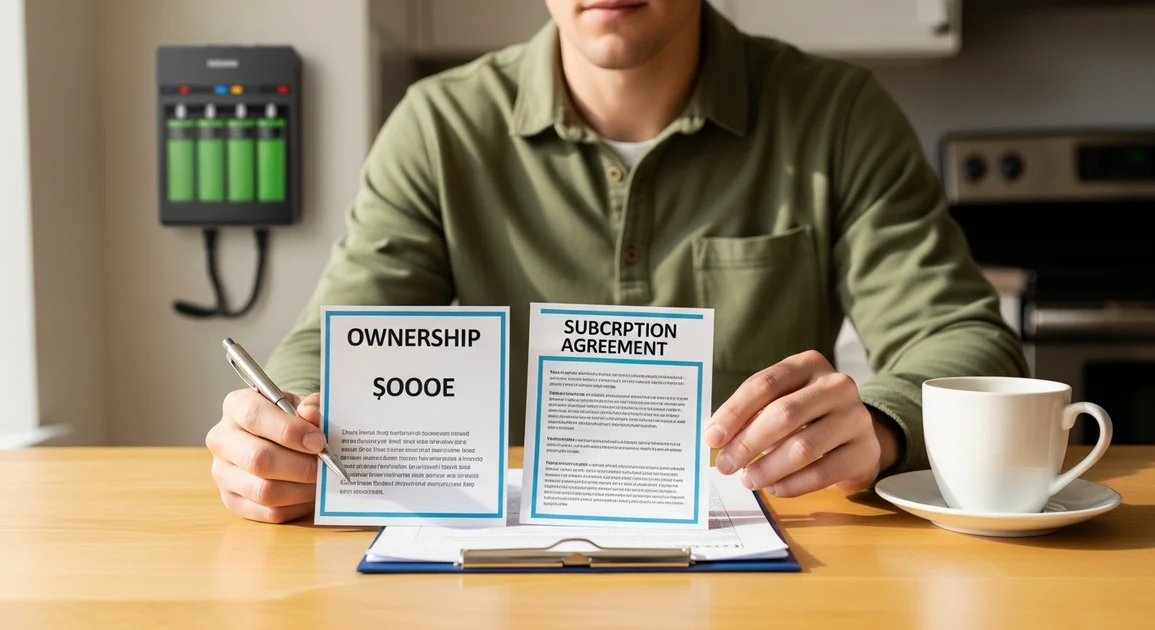
Two very different ways to get a home battery in Texas have emerged. You can own one outright, or you can subscribe to a service that installs a battery for a small upfront fee and a monthly membership. The subscription is cheaper to start and asks for little commitment. Ownership costs more upfront but leaves you with an asset you control and that can add to your home's value. This is a priorities decision, not a clear winner, and the long-run math is about more than the monthly bill.
Key Takeaways
- Subscription batteries are cheap to start. Base Power, the best-known Texas example, reports $695 to $995 upfront and $19 to $29 per month, with the provider owning the battery (Canary Media, 2025).
- Owning costs more upfront but leaves nothing recurring. An Eos Pro (27 kWh) system is $16,472 in cash, or financed and then paid off.
- In a subscription model the provider owns and dispatches the battery for grid services, so you do not fully control a battery you do not own (Utility Dive, 2025).
- Owned home-energy assets can carry a resale premium: homes with owned solar sold for about 4.1% more (Zillow, 2019), while leased systems can complicate a sale (Consumer Reports).
- Hurricane Beryl left about 2.2 million Houston-area customers without power in 2024 (Houston Public Media).
[INTERNAL-LINK: get an ownership quote for your Houston home → /home-backup-planner?source=blog&slug=base-power-vs-owning-your-battery-houston]
Should you own your home battery or subscribe in Houston?
Subscribe if you want the lowest upfront cost and the least commitment, and you are comfortable not owning the hardware. Own if you want full control of the system, an asset that can add to your home's value, and no monthly fee for the rest of the system's life. Both put a battery on your wall and both back up your home. The difference is what you have at the end.
That is why the honest comparison is not simply which is cheaper this month. It is which model matches how long you plan to stay, how much you value control, and whether you want to own what is bolted to your house.
How do the two models actually differ?
The two models differ most in who owns the battery and how you pay. A subscription service like Base Power reports a low upfront fee of $695 to $995 and a monthly membership of $19 to $29, with electricity bought through the provider at roughly 8 cents per kWh on a multi-year commitment (Canary Media, 2025). The provider designs, installs, owns, and operates the battery.
Ownership flips that. You pay for the system once, through cash or financing, and then you own it outright with no recurring fee. An Eos Pro is $16,472 in cash, or financed and paid off over a set term. After that, the battery is simply yours.
There is also a commitment difference. The subscription typically ties you to buying electricity from the provider for a multi-year term (Canary Media, 2025), so switching away later means unwinding that agreement. An owned system carries no such lock-in. Once it is yours, you can shop electricity providers freely and the battery keeps working the same way.
[INTERNAL-LINK: see what owning your system costs → /plans]
The long-run question: what do you have after ten years?
Month to month, a subscription can genuinely cost less, and that is a fair point in its favor. The long-run question is what you are left holding. After a decade of subscription payments, you own nothing and the arrangement continues. After a decade of ownership, the battery is a paid-off asset that belongs to you and can transfer with your home.
That is the real long-run math. It is not that one is always cheaper, it is that one builds toward owning an asset and the other buys a service you never own. Which matters more depends entirely on your plans for the home.
Consider a family that stays in their Houston home for fifteen or twenty years. Under ownership, the system is paid off well before then and runs at no further cost for the remaining years, and it can transfer with the house when they sell. Under a subscription, the monthly fee continues for as long as the service does, and none of those payments converts to something you keep. For a long-tenure homeowner, that gap compounds.
Ownership, equity, and home value
Owning the hardware is what lets it count as home value. The clearest evidence comes from solar: homes with owned solar panels sold for about 4.1% more, roughly $9,274 on a median home (Zillow, 2019), and a Berkeley Lab study found buyers paid about $4 per watt of installed solar (LBNL, 2015). Batteries are not solar, so treat this as the principle rather than a fixed battery figure.
The flip side is documented too. A third-party-owned or leased system can complicate a home sale, because a buyer has to assume the agreement or the seller has to buy it out (Consumer Reports). An owned battery has no such string attached.
[INTERNAL-LINK: get an ownership quote and payment options → /home-backup-planner?source=blog&slug=base-power-vs-owning-your-battery-houston]
Control, and what happens if the terms change
Control is the other quiet difference. In a subscription model the provider owns the battery and operates it, dispatching it for grid services through its own software (Utility Dive, 2025). That can be a fine trade for a lower bill, but it means the battery on your home is not fully yours to command, and its pricing, availability, and terms rest with a company whose plans can change.
An owned battery answers to you alone. When we install a system for a Houston family, they decide how it runs and no third party can change the deal later. For the flip side of this comparison, our [INTERNAL-LINK: Eos vs Base Power ownership breakdown → /blog/eos-vs-base-power-houston-ownership-vs-subscription] goes deeper on the two approaches.
[INTERNAL-LINK: talk to a local Houston installer → /home-backup-planner?source=blog&slug=base-power-vs-owning-your-battery-houston]
Prefer to talk it through? Call Eos at 713-207-2222 for a same-week Houston site survey.
Frequently asked questions
Is a subscription cheaper than owning a battery?
Month to month, often yes. A subscription reports $695 to $995 upfront and $19 to $29 monthly (Canary Media, 2025), far less to start than buying. Ownership costs more upfront but has no recurring fee and leaves you an asset.
Do I own the battery in a subscription?
No. In subscription models like Base Power, the provider designs, installs, owns, and operates the battery (Utility Dive, 2025). You are paying for a service and backup access, not for hardware you keep.
Does an owned battery add to my home's value?
Owned home-energy assets can carry resale value. Owned solar homes sold for about 4.1% more (Zillow, 2019). Batteries differ from solar, so treat this as the principle, not a guaranteed battery figure, and confirm with a local appraiser.
What if the subscription company changes prices or shuts down?
Because the provider owns the battery and sets the terms, its pricing and availability can change, and you do not control the hardware. That risk is the trade for the low upfront cost. An owned battery is unaffected by any provider's business decisions.
Can I finance an owned battery instead of paying cash?
Yes. An Eos system can be financed so you own it from day one and pay it off over a set term, after which there is no ongoing fee. That keeps ownership within reach without a large one-time outlay.
This article compares owning a home battery and subscription battery services for Houston homeowners and reflects Eos specifications and publicly reported subscription pricing as of July 2026. Subscription pricing and terms can change; confirm current details with each provider.